










Assisting Manufacturers in Complying with the Mandatory Vulnerability and Incident Reporting Obligations Taking Effect on 11 September 2026
The EU Cyber Resilience Act (CRA) – officially Regulation (EU) 2024/2847 – is the first horizontal cybersecurity regulation in the EU covering all products with digital elements. It elevates cybersecurity requirements from voluntary recommendations to mandatory legal obligations, encompassing hardware products, software applications, and associated remote data processing services. The CRA requires manufacturers to embed “security by design” principles from the product development stage and to assume cybersecurity responsibility throughout the entire product lifecycle.
Key Implementation Timeline
The CRA entered into force on 10 December 2024, with obligations phased in as follows:
| Date | Key milestones | Urgency level |
|---|---|---|
| 11 September 2026 | Mandatory reporting obligation under Article 14 takes effect – manufacturers must begin reporting actively exploited vulnerabilities and serious security incidents |  |
| 11 December 2027 | Full CRA application – all products with digital elements must comply with cybersecurity requirements before being placed on the EU market | |
Important note: The September 2026 reporting obligation applies to existing products still within their support period, including legacy products already on the EU market.
Article 14: The Most Stringent Compliance Challenge
Article 14 of the CRA requires manufacturers to report:
- Actively exploited vulnerabilities – where there is evidence of actual attacks or proof‑of‑concept (PoC) in circulation
- Serious security incidents – e.g., malicious code injection, large‑scale data breaches, or widespread device disruption
The reporting deadlines are extremely tight:
| Timeframe | Requirement |
|---|---|
| Within 24 hours | Early warning notification (to the national CSIRT and ENISA) |
| Within 72 hours | Detailed incident report (impact, scope, mitigation measures) |
| Within 14 days / 1 month | Final report (after remediation completion or incident closure) |
For globally distributed teams, time‑zone differences, incidents occurring over weekends, and multilingual reporting requirements create significant operational pressure.
Consequences of Non‑Compliance
Failure to meet CRA requirements carries severe penalties:
- Fines: Up to 2.5% of global annual turnover or €15 million, whichever is higher
- Market enforcement measures: Product bans, mandatory recalls, withdrawal from the EU market
- Other consequences: Disgorgement of ill‑gotten gains, market access restrictions, and consumer class‑action lawsuits
CMA Testing: End‑to‑End Automated Solution for Article 14 Compliance
CMA Testing now offers a cloud‑based automated vulnerability reporting service that meets regulatory requirements and is specifically designed to address the operational and technical challenges of Article 14:
- Automated SBOM generation and management: Automatically generates or imports Software Bill of Materials (SBOM), with real‑time integration with global vulnerability databases to deliver comprehensive impact analysis within 10 minutes
- VEX intelligent filtering: Integrates Vulnerability Exploitability Exchange (VEX) mechanisms to automatically filter out over 60% of false positives, significantly reducing reporting workload while maintaining compliance accuracy
- AI‑driven reporting automation: Built‑in AI compliance assistant automatically generates ENISA‑compliant English reports (early warning, detailed report, final report) – with one‑click human confirmation before direct submission to the ENISA platform, ensuring reliable adherence to the 24‑hour / 72‑hour reporting deadlines
- End‑to‑end visibility and coordinated disclosure: Real‑time dashboards display compliance deadlines and reporting status; integrated Coordinated Vulnerability Disclosure (CVD) portal unifies internal and external reporting channels
- Audit‑ready compliance and 24/7 monitoring: Full activity logging ensures regulatory traceability; automated compliance record archiving; 24/7 monitoring and alerting ensure zero reporting gaps
Act Now
CRA Article 14 is a zero‑transition, zero‑exemption requirement. All digital products already on the EU market must have a compliant reporting mechanism in place by 11 September 2026.
Leveraging its deep expertise in compliance and certification, CMA Testing is committed to helping manufacturers address CRA compliance challenges in an efficient, accurate, and scalable manner.
Contact us:
Hong Kong:
- Tel: (852) -26988198
- Email: info@cmatesting.org
Shenzhen:
- Tel: (86) 0755-88350808
- Email: info.sc@cmatesting.org
Shanghai:
- Tel: (86) 021-64330500
- Email: info.sh@cmatesting.org

Author: Ronald Lui; Proofread by Ryan Lau
Summary
- Performance-based verification confirms that buildings support real occupant health and well-being, not just design intent.
- WELL Certification focuses on measurable indoor environmental quality across air, water, lighting, acoustics and thermal comfort.
- Independent on-site testing is a core requirement of WELL Certification and recertification processes.
- Third-party verification helps identify operational gaps early and provides credible evidence for certification and ongoing building performance.
Accurate testing and verification improve transparency, occupant confidence and long-term building resilience.
Global attention on healthy, resilient and human-centric buildings is accelerating, and building owners are increasingly required to demonstrate, with data, that indoor environments genuinely support occupant health and well-being. Performance-based standards like the WELL Building Standard respond to this shift by coupling design intent with rigorous, third-party on-site testing of real operating conditions. For organisations in Hong Kong and the region, WELL has become a key benchmark for health-focused buildings, reshaping expectations around indoor environmental performance, transparency and independent verification.
WELL is useful because it translates broad health goals into measurable building conditions. Rather than relying only on design documents, it checks whether the occupied space actually performs as intended for air, water, light, sound and thermal comfort.
WELL Standard introduction
The WELL Building Standard, now most commonly implemented as WELL v2, is a global, performance-based framework for designing, operating and certifying buildings that support human health and well-being. It is administered by the International WELL Building Institute (IWBI) and certified through Green Business Certification Inc. (GBCI), with requirements organised around measurable outcomes rather than purely prescriptive design rules. WELL v2 builds on the earlier WELL v1 approach and expands the certification structure into concepts such as Air, Water, Light, Thermal Comfort, Sound, Materials, Mind, Community and Movement.
A defining feature of WELL is performance verification. After design and construction, a trained WELL Performance Testing Agent performs on-site testing and visual inspections to confirm that measured indoor conditions meet WELL’s health-based criteria. The WELL Performance Verification Guidebook standardises test methods, sampling strategies, measurement equipment requirements and reporting expectations, so results are comparable across markets and project types.
When performance testing is required
For WELL v2 certification, performance testing is required wherever a feature uses a performance-test verification pathway. In other words, projects cannot substitute self-collected measurements for these features unless the specific feature explicitly allows another method such as sensor data or documentation-based evidence. This is why performance testing is a core part of WELL certification, not an optional add-on.
For WELL Ratings and recertification, on-site testing is also required for features that specify performance testing, and results must be submitted during the relevant review cycle. Some WELL Ratings features allow sensor data instead of performance testing, but that exception applies only where the standard explicitly permits it. In practical terms, any project pursuing WELL through the performance-test route needs to plan early for an approved Performance Testing Provider, especially when the project seeks certification, renewal or portfolio-wide consistency.
Why verification matters
WELL performance testing is important because it checks real environmental conditions, not just design intent. Buildings can look compliant on paper while still failing in operation due to poor maintenance, user behaviour, system drift or unanticipated site conditions. Third-party testing reduces this gap by giving project teams and reviewers objective evidence that the building is performing as expected.
A robust verification process delivers several benefits. It provides proof that health-focused strategies, such as filtration, water treatment, lighting controls or acoustic treatments, are functioning properly under normal use. It also identifies performance gaps early, allowing targeted corrective action before certification or renewal decisions are made. Just as important, it creates a repeatable evidence base that can support portfolio benchmarking and ongoing building operations.
Technical focus areas
Air quality
Indoor air quality is one of the most scrutinised WELL areas because it has a direct link to respiratory health, comfort and cognitive performance. WELL performance testing may include formaldehyde, volatile organic compounds, PM2.5, PM10 and ozone, depending on the feature requirements and project conditions. Testing is usually conducted at representative locations under normal operating conditions so the results reflect actual occupant exposure.
Technical accuracy matters here because pollutant levels can be influenced by ventilation rates, filtration, outdoor air infiltration and indoor source control. A good testing programme therefore does more than take a reading; it confirms that the building’s air delivery and control strategy work in practice.
Water quality
Water quality verification typically involves point-of-use sampling and laboratory analysis for microbiological and chemical indicators. Common parameters include coliforms, turbidity and disinfectant-related factors, depending on the WELL feature being pursued. Sampling must be handled carefully, because improper collection or transport can affect results and create uncertainty.
This part of WELL is especially relevant in buildings with central treatment systems, long pipe runs or variable local supply conditions. Testing confirms that the water actually available to occupants meets the expected quality threshold and that the building’s treatment or distribution systems are working properly.
Thermal comfort
Thermal comfort verification checks whether occupants are likely to experience stable, acceptable conditions in normal use. Measurements commonly include dry-bulb temperature, mean radiant temperature and relative humidity, with results interpreted against comfort models such as PMV and related indices. These variables help show whether HVAC systems are balanced and operating as intended across occupied zones.
This is a practical area because thermal complaints often come from localised issues rather than a single building-wide fault. WELL testing can reveal uneven temperature distribution, control instability or settings that are technically acceptable but uncomfortable in use.
Acoustics
Acoustic performance is central to concentration, privacy and stress reduction in workplaces and public buildings. WELL verification commonly covers background noise, reverberation time and sound insulation, depending on the feature and space type. The aim is not only to reduce excessive noise but also to make spaces usable for speech, focus and rest.
Acoustic testing needs proper equipment, calibrated procedures and careful site interpretation because results can vary significantly between rooms and occupancy states. In open-plan offices or mixed-use buildings, this kind of testing helps identify whether the acoustic design is actually performing as intended.
Lighting
Lighting performance in WELL extends beyond simple brightness. It may include visual lighting checks, circadian-related metrics and other measurements that confirm the space supports both task performance and occupant well-being. The key idea is that light should be measured in the occupied environment, not assumed from design specifications alone.
This makes lighting verification especially relevant for buildings that use daylighting strategies, automated controls or layered lighting systems. WELL testing helps confirm that the system delivers useful light levels while supporting visual comfort and, where relevant, circadian intent.
Role in certification
Within the WELL certification process, performance testing sits between documentation review and final verification. The project team first submits design and policy documentation, then the on-site performance tests confirm whether the building meets the operational criteria required for certification. If measurements fail to meet the threshold, the project may need corrective action and retesting before certification can proceed.
The Performance Testing Provider is therefore the independent technical party that turns WELL from a document-based system into an evidence-based one. It coordinates sampling, executes tests, maintains quality control and submits results through the correct WELL workflow. This role is critical because WELL certification depends not only on what was designed, but on what the building actually delivers in use.
CMA Testing’s role
CMA Testing is officially accredited as a WELL Performance Testing Provider through IWBI and GBCI. This means CMA Testing is authorised to conduct the on-site performance verification required for projects pursuing WELL Certification, supported by a team that includes WELL APs and WELL Performance Testing Agents. As a result, CMA Testing can help projects complete the technical verification stage in a way that is aligned with WELL’s quality and independence requirements.
In practice, CMA Testing’s role is to provide the technical testing backbone of the certification process. That includes air, water, thermal comfort, acoustics and lighting measurements, along with the documentation and quality controls needed for GBCI review. Its contribution is best understood as independent assurance: helping project teams demonstrate, with credible evidence, that the building’s health-focused design is working in real life.

Author : Harris Wan
Key Points
- Global regulatory framework for Food Contact Materials (FCM)
- EU, US, China, and Japan compliance requirements comparison
- Positive List regulatory approach explained
- Japan FCM regulatory reform fully implemented in 2025
- PFAS restrictions and emerging chemical compliance risks
- Migration limits (OML/SML) and testing considerations
- Sustainable packaging and recycled material compliance trends
- Key compliance strategies for global market access
In today’s society, food safety has become a major public concern. From pesticide residues to food additives, consumers are increasingly attentive to the quality and safety of food itself. However, compared with food safety, the safety of Food Contact Materials (FCMs) is often overlooked, despite being closely related to food safety.
FCMs include materials such as plastics, rubber, paper, metals, and coatings used in food packaging, containers, and utensils. These materials may release harmful substances when in contact with food, potentially affecting food safety. According to EU FCM regulations, materials must not transfer harmful substances to food in quantities that could endanger human health, change the composition of food, or negatively affect its sensory properties.
Globally, regulatory control of FCMs is becoming increasingly stringent. Among different regulatory approaches, the positive list system has become the dominant model. This article reviews global FCM regulatory frameworks with a particular focus on Japan’s recent reform, highlighting key trends shaping the future of FCM compliance.
Global Overview of FCM Regulations
Globally, FCM regulatory frameworks can be broadly categorized into two main approaches:
- The flexible premarket notification system represented by the United States
- The stricter positive list system represented by the European Union
The positive list system requires that only substances which have undergone safety evaluation and are included on an approved list may be used in the manufacture of FCMs. This approach provides stronger risk control but may also increase compliance costs for industry. Many countries and regions have adopted or partially adopted this system.
The European Union is among the earliest and most comprehensive adopters of the positive list approach. Regulation (EU) No 10/2011 establishes the Union List, which includes all authorized monomers, additives, and polymer production aids permitted in plastic FCMs. Only substances included on the list may be used. The regulation also defines Specific Migration Limits (SML) and Overall Migration Limits (OML). Since its implementation in 2011, the regulation has been continuously updated, including the 2025 revision introducing new substances and updated migration requirements.
China also applies a positive list-based framework. In 2016, National Health Commission of the People’s Republic of China issued the National Food Safety Standard: General Safety Requirements on Food Contact Materials and Articles (GB 4806.1-2016), together with a series of related standards.1 These include general safety requirements, technical requirements for specific materials, and testing methods. Appendix A of GB 4806.6-2016 lists a detailed positive list, while GB 9685-2016 lists all the standards for the use of additives in FCM.
Regulatory authorities such as State Administration for Market Regulation (SAMR) and China National Center for Food Safety Risk Assessment (CFSA) periodically review and approve new substances2, reflecting China’s increasing focus on FCM safety as a major global manufacturing hub.
Japan introduced its positive list system in 2020, with full implementation effective on 1 June, 20253. The system mainly applies to synthetic resins, requiring safety assessment of substances prior to use. The positive list is structured as appended tables, specifying permitted polymers4, additives5, usage limits, and conditions. Certain thermosetting elastomers such as rubber remain regulated under a negative list approach. Japan’s reform aims to align its regulatory framework with international standards and enhance product safety.
Other countries adopting positive list systems include:
- India – Food Safety & Standards (Packaging) Regulations 20186
- Indonesia – BPOM Regulation No. 20 of 20197
MERCOSUR – GMC resolutions harmonized these regulatory developments demonstrate a global trend toward proactive risk control through pre-evaluation of materials.
In contrast, the U.S. FDA applies a hybrid system combining existing substance listings under 21 CFR and the Food Contact Notification (FCN) process for new substances. This approach allows greater flexibility and innovation, though preventive control may be less stringent than under the positive list system.
Evolution of Japan’s FCM Regulatory Framework
Japan has a long history of regulating FCMs. In 1959, the Ministry of Health, Labour and Welfare issued Notification No. 370, establishing Standards and Standards for Food, Additives, etc. specifications and standards for foods, food additives, containers, and packaging. Initially, the regulatory approach relied primarily on a negative list system, prohibiting certain hazardous substances without comprehensive pre-approval requirements.
For several decades, regulatory development remained limited, resulting in a gap between Japan and other developed regions. On 12 June, 2018, Japan amended the Food Sanitation Act and introduced the positive list system8, marking a significant regulatory shift.
The positive list system officially took effect on 1 June, 20209, with a five-year transition period.
The system applies mainly to plastic materials and additives, with authorized substances listed in Appended Table 110 along with an implementation notice11, which serves as an elaboration and explanatory note. Only listed substances may be used unless evaluated and approved by the Ministry of Health, Labour and Welfare (MHLW).
Following the transition period, full implementation began on 1 June, 2025. Additional structural changes reorganized regulatory provisions and removed certain physical testing requirements for high-temperature sterilized packaging. Importantly, Japan strengthened Overall Migration Limits for plastic FCMs12, creating a dual regulatory structure combining positive and negative list controls. The amendments, except the Overall Migration requirement that will become effective on 1 June 2026, have come to effective on 1 June, 2025.
Global Importance and Future Trends of FCM Regulation
Although large-scale incidents directly caused by FCMs are relatively rare13, their impact is often long-term and cumulative14. Positive list systems offer a preventive approach by ensuring only assessed substances enter the supply chain. This explains why regions such as the EU, China, and Japan have adopted this regulatory model.
Key future regulatory trends include:
- Expansion of regulatory scope: EU, as an example, suggests extending the coverage to paper, metals, glass, coatings, silicone, and inks, as well as escalate the regulation from member states’ level to EU’s level15; while China has been updating the FCM specifications for newly added materials;
- Increased scrutiny on key chemical residues: with perfluorinated and polyfluoroalkyl substances (PFAS) showing the most significant trend. The US FDA began phasing out PFAS compounds from certain food packaging in 202416, and many states have enacted legislation to completely ban them; on the other hand, the EU has explicitly banned PFAS in food packaging materials after 12 August, 2026, in its Packaging Materials Directive17. It is expected that more and more regions will join the ranks of those banning PFAS in food packaging materials in the future;
- Recycling and reuse: For example, one of the EU’s recent development directions is to support innovation and sustainability18 by promoting safe, reusable, and recyclable solutions; while China is also actively exploring regulations for recycled FCMs (such as rPET materials)19, and it is expected that regulations in this area will become increasingly stringent in the future.
For consumers, understanding FCM regulations helps ensure safer product choices. For businesses, compliance is essential for market access. Japan’s reform demonstrates how regulatory systems are evolving toward more scientific and comprehensive approaches to ensure food safety.
1 Announcement on the Issuance of 53 National Food Safety Standards Including General Safety Requirements for Food Contact Materials and Articles (GB 4806.1-2016) (Announcement No. 15 of 2016)
https://www.nhc.gov.cn/sps/c100088/201611/6f792a23fc294c1a90bebbbac1edf288.shtml
2 These standards include:
- GB 4806.14-2023 – National Food Safety Standard: Inks for Food Contact Materials and Articles
- GB 4806.15-2024 – National Food Safety Standard: Adhesives for Food Contact Materials and Articles
- GB 4806.16-2025 – National Food Safety Standard: Silicone Rubber Materials and Articles for Food Contact Use
3 Integration update conducted on 13 November 2023
4 Appended Table 1 – Table 1 (Permitted Polymers)
5 Appended Table 1 – Table 2 (Permitted Additives and Restrictions)
6 Schedule III of the regulation specifies technical requirements for certain materials, but does not explicitly prohibit the use of plastics outside the listed materials.
7 BPOM Regulation No. 20 of 2019 and its amendments. Annex 3 lists authorized substances, while Annex 4 specifies prohibited substances.
8 Official announcement on amendments to Japan’s Food Sanitation Act
https://www.mhlw.go.jp/stf/seisakunitsuite/bunya/0000197196.html
9 Following implementation in 2020, multiple technical updates and refinements were introduced
https://www.mhlw.go.jp/stf/newpage_05148.html
10 Official website of the Positive List system
11 Monomers, etc. constituting the base materials specified in Table 1 of Appended Table 1 of Specifications and Standards for Foods, Food Additives, etc.
Japanese version:
English version (notification only, excluding annex tables):
12 Previously, Overall Migration Limits (OML) requirements were only applicable to certain specific plastic materials.
13 Although large-scale incidents directly caused by FCM are rare, smaller incidents occasionally occur. For example, in 2024, multiple lawsuits were filed against Hershey Company alleging the presence of per- and polyfluoroalkyl substances (PFAS) in chocolate packaging, which may migrate into food. Additionally, in 2012, the EU warned about the potential presence of harmful mineral oil residues in recycled paper-based food packaging.
https://efsa.onlinelibrary.wiley.com/doi/pdf/10.2903/j.efsa.2012.2704
14 Studies conducted in the 2010s identified migration of Bisphenol A (BPA) from baby bottles and can linings, leading to regulatory bans on BPA in infant products across the EU, Canada, and the United States.
EU restriction:
https://www.europarl.europa.eu/doceo/document/P-7-2010-3848_EN.html
Canada restriction:
https://laws-lois.justice.gc.ca/eng/acts/C-1.68/page-7.html#h-44890
FDA announcement:
https://abcnews.com/Business/fda-officially-bans-bpa-bisphenol-baby-bottles/story?id=16799087
15 See final page of the official report
https://www.europarl.europa.eu/RegData/etudes/STUD/2016/581411/EPRS_STU(2016)581411_EN.pdf
16 FDA: Authorized Uses of PFAS in Food Contact Applications
https://www.fda.gov/food/process-contaminants-food/authorized-uses-pfas-food-contact-applications
Other contact materials, such as non-stick cookware, may still contain PFAS due to low migration potential.
17 Regulation (EU) 2025/40 (PPWR), Article 5(5), defines PFAS restrictions applicable to food packaging materials
https://eur-lex.europa.eu/legal-content/EN/TXT/?uri=CELEX:32025R0040
18 Revision of EU rules on Food Contact Materials
19 Report on upcoming updates to GB 4806.1
https://www.complianceandrisks.com/blog/key-takeaways-from-the-food-contact-asia-conference-2025/
click to download
Key Points
- Global climate regulations are tightening, driving demand for accurate and verifiable greenhouse gas (GHG) data.
- ISO 14064-1 provides structured requirements for organisational greenhouse gas (GHG) quantification, boundaries, data quality and uncertainty management.
- ISO 14064-3 ensures greenhouse gas (GHG) statements are transparent, consistent and assurance-ready.
- Major regulatory frameworks align with ISO standards, including:
EU Carbon Border Adjustment Mechanism (CBAM) – harmonised methods & mandatory verification
China Emissions Trading System (ETS) – strengthened monitoring, reporting, and verification (MRV) and activity-data traceability
HKEX IFRS S2 – assurance-ready climate disclosures from 2025
EU Ecodesign for Sustainable Products Regulation (ESPR)/ Digital Product Passport (DPP) – ISO-based organisational data for product carbon transparency
- ISO 14064 enables unified, comparable and audit-ready greenhouse gas (GHG) data across markets.
- Standard Introduction
ISO 14064‑1:2018 specifies organization‑level requirements for quantifying and reporting greenhouse gas (GHG) emissions and removals. It addresses organizational and operational boundaries, identification of sources and sinks, selection of quantification methods, data quality and uncertainty management, and reporting under the principles of relevance, completeness, consistency, accuracy and transparency. The standard is programme‑neutral, enabling inventories to support multiple regimes.
ISO 14064‑3:2019 sets principles and requirements for verification of greenhouse gas (GHG) statements, including assurance level, materiality, risk‑based planning, evidence evaluation, competence and impartiality—turning inventories into decision‑grade statements.
2. Importance of greenhouse gas (GHG) Inventory Quantification and Verification
Growing global regulatory pressure is rapidly reshaping how organisations quantify, manage and disclose greenhouse gas (GHG) emissions. A technically robust greenhouse gas (GHG) inventory, developed in full accordance with ISO 14064‑1:2018 and subsequently verified under ISO 14064‑3:2019, has become a foundational requirement for compliance with both established statutory frameworks and newly emerging regulatory schemes.
2.1 EU – Carbon Border Adjustment Mechanism
Carbon Border Adjustment Mechanism (CBAM)’s technical documentation embeds explicit expectations for harmonised quantification and third‑party verification of embedded emissions for specified carbon‑intensive goods. Under the definitive phase effective 2026, importers must apply prescribed system boundaries, enforce mandatory reporting of activity data at installation level, and adopt conservative assumptions where data uncertainty is high. These requirements closely mirror ISO 14064‑1’s rules on:
- Boundary selection
- Activity‑data traceability and evidence chains
- Emission factor justification and hierarchy
- Uncertainty characterization
Additionally, ISO 14064‑3’s verification approach, which includes materiality assessment, rigorous evidence gathering and risk‑based verification planning, directly parallels the verification procedures required under Carbon Border Adjustment Mechanism (CBAM). This alignment ensures that greenhouse gas (GHG) statements meet CBAM’s expectations for accuracy and reproducibility.
2.2 Mainland China – Reinforcement of National Emissions Trading System (ETS) monitoring, reporting, and verification (MRV) Requirements
China’s strengthening of its national Emissions Trading System (ETS) incorporates increasingly stringent monitoring, reporting, and verification (MRV) requirements, emphasising high‑resolution activity data, sector‑specific methodologies, and third‑party verification. ISO 14064‑1 provides a compatible framework through:
Structured categorisation of emission sources and sinks aligned with Emissions Trading System (ETS) sectoral guidelines
Activity‑data governance requirements, including documentation, traceability and quality controls
Mandatory uncertainty management, which is necessary for Emissions Trading System (ETS)‑compliant reporting
ISO 14064‑3’s verification model—focused on risk identification, validation of internal controls, and cross‑checking of measurement‑based and calculation‑based data—supports enterprises in meeting Emissions Trading System (ETS) verification standards as the system expands and tightens toward 2027.
2.3 Hong Kong – HKEX IFRS S2‑Aligned Climate Disclosure Requirements
HKEX has introduced the New Climate Requirements, effective for reporting periods beginning on or after 1 January 2025. To comply with the New Climate Requirements, issuers must establish quantification and reporting processes capable of producing transparent, traceable and assurance‑ready greenhouse gas (GHG) data. This includes:
- Clear organisational boundary determination, ensuring consistent attribution of Scope 1 and Scope 2 emissions.
- Methodological consistency in calculating emissions, including justified selection of activity data and emission factors.
- Controlled data management, including documentation of data sources, versioning of emission factors and maintenance of data lineage.
- Quantitative uncertainty assessment, aligned with internationally recognised greenhouse gas (GHG) quantification principles (e.g., ISO‑based approaches).
Given that HKEX’s climate disclosure framework is aligned with IFRS S2, where verifiability, consistency and audit‑readiness are essential principles, ISO 14064‑1 and ISO 14064‑3 provide the structural foundation needed for compliance. By adopting ISO 14064 based systems, issuers can ensure that their disclosures not only comply with HKEX requirements but also meet future expectations for external assurance, international comparability and progressive regulatory tightening.
2.4 EU- Ecodesign for Sustainable Products Regulation (ESPR)
Though Ecodesign for Sustainable Products Regulation (ESPR) applies at the product level, it presupposes a technically sound organisational greenhouse gas (GHG) inventory as a prerequisite for accurate lifecycle‑based assessments. Compliance with Ecodesign for Sustainable Products Regulation (ESPR)’s anticipated requirements, such as Digital Product Passport (DPP) emissions transparency, requires the following:
- A complete and uncertainty‑quantified organisational greenhouse gas (GHG) baseline, derived from ISO 14064‑1
- Methodological coherence between organisational inventories and product‑level calculations (e.g., ISO 14067)
- Evidence‑based verification controls, aligning with ISO 14064‑3’s materiality and sampling rules
Thus, ISO 14064‑1 and ISO 14064‑3 enable organisations to construct the data infrastructure necessary to support Ecodesign for Sustainable Products Regulation (ESPR)’s product‑level quantification, verification and digital‑traceability demands.
3. CMA Testing’s Role
CMA Testing, originating from the Chinese Manufacturers’ Association and carrying a longstanding mandate to support industrial development, has continuously expanded its technical competence in environmental and sustainability assessment. The organisation is accredited by the Hong Kong Accreditation Service(HKSA) for greenhouse gas (GHG) inventory quantification under ISO 14064‑1:2018 and greenhouse gas (GHG) verification under ISO 14064‑3. Through HKAS’s participation in the multilateral recognition arrangements of the International Accreditation Forum, the International Laboratory Accreditation Cooperation and the Asia Pacific Accreditation Cooperation, the results issued within the accredited scope are internationally recognised, reflecting the principle of accredited once, accepted everywhere.
Against this regulatory backdrop, CMA Testing supports industries in strengthening their organisational readiness through the following integrated roles.
3.1 Building reliable and standardised greenhouse gas (GHG) inventory systems
A credible greenhouse gas (GHG) inventory forms the foundation of all climate‑related disclosure and compliance work. CMA Testing assists organisations in designing and implementing ISO 14064‑aligned systems that define clear boundaries, establish traceable data collection processes and maintain consistent methodologies over time. By embedding evidence chains, data lineage and uncertainty management into routine operations, companies can shift from fragmented carbon accounting practices to structured and verifiable greenhouse gas (GHG) data governance. This foundation is essential for meeting regulatory expectations under HKEX, Carbon Border Adjustment Mechanism (CBAM), Emissions Trading System (ETS) and other emerging regimes.
3.2 Strengthening assurance readiness and internal controls
As external assurance becomes increasingly central to climate reporting frameworks, organisations must ensure that their greenhouse gas (GHG) statements can withstand rigorous verification. CMA Testing supports this process by conducting gap analyses against ISO 14064‑1 and ISO 14064‑3, carrying out pre‑verification assessments and helping enterprises establish effective internal controls to reduce material uncertainties. This enables organisations to produce assurance‑ready disclosures that meet the expectations of regulators, auditors and investors.
3.3 Reducing compliance burden for SMEs and large enterprises
Many companies in Hong Kong and the region lack dedicated environmental teams, which can make compliance with new climate regulations challenging. CMA Testing addresses this by providing practical guidance and tools such as structured activity‑data templates, sector‑specific emission‑factor recommendations and uncertainty‑reduction practices. These resources allow enterprises to meet regulatory requirements efficiently while maintaining technical integrity.
3.4 Supporting alignment across multiple regulatory regimes
Supply chains are now operating under increasingly overlapping regulatory jurisdictions. CMA Testing helps organisations align their methodologies across HKEX, Carbon Border Adjustment Mechanism (CBAM), China Emissions Trading System (ETS) and the Ecodesign for Sustainable Products Regulation (ESPR), ensuring consistency in carbon accounting practices. This includes harmonising organisational greenhouse gas (GHG) inventories with product carbon footprint methodologies based on ISO 14067 and building data management systems capable of supporting future requirements such as the Digital Product Passport.
3.5 Delivering internationally recognised end‑to‑end greenhouse gas (GHG) services
With its accredited competencies and sector experience, CMA Testing provides a full suite of greenhouse gas (GHG)‑related services, including ISO 14064‑1 inventory quantification and reporting, ISO 14064‑3 verification with reasonable or limited assurance, and advisory services that help organisations align their reporting processes with IFRS S2, the greenhouse gas (GHG) Protocol, Carbon Border Adjustment Mechanism (CBAM) and Emissions Trading System (ETS) monitoring, reporting, and verification(MRV) requirements. These services support companies in transforming climate compliance from a regulatory obligation into a strategic capability that enhances supply‑chain confidence and global market access.
For inquiries about related services, please contact:
HK, China
Eva Kung evakung@cmatesting.org
SZ,China
Clara Chu (+86) 138 2880 6404 clarachu@cmatesting.org
SH,China
Yuki Zheng (+86) 021 6433 0500*388 yukizheng@cmatesting.org
Key Points
- Fire events in Hong Kong exposed safety gaps, leading to strict flammability requirements for upholstered furniture in public premises.
- FSD Circular No. 1 (2000) mandates compliance with BS 7176 and proper labeling/test reports.
- Updated BS 7176:2007+A1:2011 adds mandatory ignitability testing for each filling material, addressing risks missed by the 1995 version.
- Only the new version is internationally valid, and more government buyers already require it, pushing the industry toward enhanced fire safety.
When you go to restaurants, theaters or hotels, you will notice that the upholstered chairs will have the following label (Figure 1) to indicate that the upholstered chairs have complied with the fire safety standards.

(Figure 1)
The recent fire event echoes the another fire event in 1996 exposing similar vulnerabilities in aging structures, including inadequate fire-fighting equipment, flammable renovation materials, and interior furnishings like upholstered furniture, carpets, and curtains. The 1996 event directly prompted the Hong Kong government to enact stringent flammability regulations for such items in licensed premises and public areas.
In 2000, the Fire Services Department published “Fire Services Department Circular No. 1 of 2000, Flammability Standards for Polyurethane Latex Mattress and Upholstered Furniture in Licensed Premises and Public Places” (Ref. 1), requiring The flammability standards for polyurethane latex mattresses and fixed and removable upholstered furniture used in licensed premises and public places are excerpted for upholstered furniture as follows:
Upholstered furniture is required to comply with BS 7176:1995 (Ref. 2) for fire resistance testing of composite seats for non-domestic use (moderate hazard premises/buildings) or equivalent international standards.
The use of polyurethane foam filled furniture that meets the specified standards in licensed premises and public places shall have an appropriate label (as shown in Figure 1), the invoice with accredited test report issued by an accredited laboratory must be submitted by relevant manufacturer/suppliers to relevant department officer for checking.
The following (Table 1) is a summary of BS 7176: 1995 (Medium Hazard Premises/Buildings)
| BS 7176:1995 Specification | Application |
| Resistant to ignition source: smouldering cigarette of BS EN 1021-1 : 1994. Resistant to ignition source: match flame equivalent of BS EN 1021-2 : 1994. Resistant to ignition source 5 in section 4 of BS 5852 : 1990. | Hotel bedrooms Public buildings Restaurants Services’messes Places of public entertainment Public halls Public houses and bars Casinos Hospitals Hostels |
To understand this standard, you should firstly understand the ignition sources (Figure 2) and ignition methods (Table 2) of the British Standard Specifications, so that readers can easily understand:
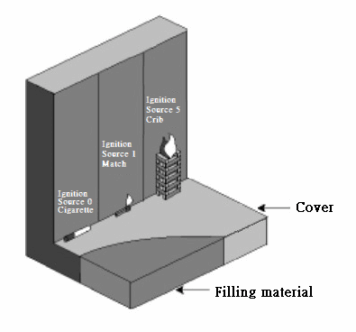
| Cigarette ignition test (Ignition source 0) | Match ignition test (Ignition source 1) | Wooden crib ignition test (Ignition source 5) |
 |  |  |
| After the sample has been pre-conditioned and maintained at constant temperature and humidity, place one of the customer’s fillings vertically and horizontally on the test rack and wrap it with the submitted fabric sample. Place a standard cigarette on the junction between the vertical and horizontal fillings. Then ignite and observe. | After the sample has been pre-conditioned and maintained at constant temperature and humidity, place one of the customer’s fillings vertically and horizontally on the test rack and wrap it with the submitted fabric sample. Place a burner with specified gas flow and energy on the junction between the vertical and horizontal fillings. Then ignite and observe. | After the sample has been pre-conditioned and maintained at constant temperature and humidity, place one of the customer’s fillings vertically and horizontally on the test rack and wrap it with the submitted fabric sample. Place a standard wooden crib on the junction between the vertical and horizontal fillings. Then ignite and observe. |
Per BS 7176:1995, filling and covering fabrics (which treated with water soaking) assembled as composite materials in accordance with the standard are tested in accordance with the required methods listed in the table above. When the results of the cigarette, match and wooden crib ignition tests of the composite material are all “non-ignition”, then it meets the Medium Hazard requirements of BS 7176:1995.
To provide consumers with greater safety protection, BS 7176:1995 has been updated in different ways over the past 20 years, and the latest version is BS 7176:2007+A1:2011 (Ref. 3). The most important update to the specification is the addition of the ignition test for filling materials. All fillings used in upholstered chairs must be tested for individual fillings in accordance with the guidelines in the Annexes (A to E) of the standard. These annexes will direct you to the corresponding provisions of the UK Furniture and Furnishings (Fire) (Safety) Regulations 1988 (Ref. 5) for testing. This updated standard specification can only be concluded to comply with the requirements only if the ignitability test of the composite material covered with fabric wrapped filling and each of its filling materials yields a “non-ignition” result at the same time.
In terms of consumer protection, this updated version has indeed improved fire safety due to the above specifications; however, it has also increased the production and testing costs of manufacturers. They believe that if the composite material is “non-ignition”, the filling material does not necessarily require “Non-ignition”. It’s because the final upholstered furniture is in a composite state rather than a separate material, consumers will not directly contact and ignite the filling material individually during normal use, so they regard the ignitability test of the added filling material just as optional. According to statistics surveyed by CMA Testing from August 2007 to January 2026, only an average of 8% of BS7176 tests were requested in an updated version. From this data, it shows that local and mainland manufacturers have been in passive response. Unless buyers specify a new version of the test, they usually request the old version for this specification test. One of reasons for them to use the old version in local use is it’s still acceptable to apply the license in local public premises.
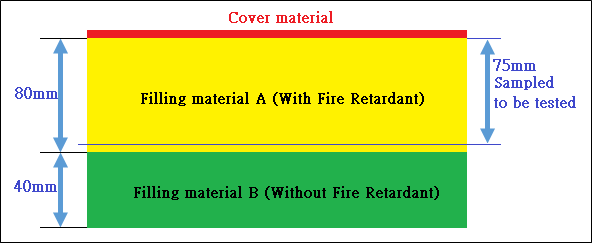
From a technical perspective, the old version (BS 7176:1996) test can only determine that when a single filling material is used in an upholstered chair, the composite material is “non-ignition” and the result is truly “non-ignition”. However, for upholstered chairs using two or above filling materials, when the composite filling material is composed of multiple layers and its total thickness exceeds 75 mm, the relevant test method standards BS5852:1990 (Ref. 5) or BS5852:2006 (Ref. 6) guides only the upper 75 mm of multi-layers filling material to be assembled with covering fabric for ignition testing.
Figure 3 below shows an upholstered chair with two filling materials (A with and B without fire retardant treatment) as an example, the thicker upper layer of filling material A was tested on a composite sample with a filling material thickness of 75±2 mm. The samples can be completely sampled from filling material A, but the filling material B in the lower layer without fireproof treatment has not been sampled and tested, which may lead to false “non-ignition” of the composite sample. Although the above situations are rare, in terms of safety risks, adopting the updated version of the test specification can remove the above limitations of the old version of the test and ensure that the fire safety of upholstered furniture is fully in place.
In terms of standard traceability, BS 7176:2007+A1:2011 has replaced the withdrawn BS 7176:1995 for many years and the withdrawn BS 7176:1995 has not been recognized internationally. Therefore, if there is a legal dispute, the court shall follow the effective standard BS 7176:2007+A1:2011. Hence, when the customer requires our laboratory to test BS 7176 without indicating the new or old version, we shall inform the customer of the above situation to confirm the new or old version to be followed for testing. At present, foreign buyers and some Hong Kong government departments have referred to the updated version of BS 7176:2007+A1:2011 as one of the receiving specifications in purchasing.
As we move forward, it is imperative that both local authorities and private stakeholders align their practices with updated flammability standards. The commitment to enhancing policy formulation, supervision, and law enforcement will play a crucial role in preventing similar fire events. A concerted effort to implement these guidelines will ensure a safer environment for all, fostering not only compliance but a culture of safety in commercial and public spaces. Together, we can work towards a future where such disasters are not just rare but entirely avoidable.
*** The End ***
Reference
Remark:
Due to the time in publishing, the regulation, standard and letter versions information stated above may be changed after the article composed date of 1 February 2026.

Background
Plastic is definitely one of the most important inventions in human history: nowadays, plastic materials are widely used in many circumstances. Their usage ranges from composite materials in aircraft to plastics in general consumer products. Despite their versatility, plastic also causes one of the biggest environmental crises in the 21st century, due to their durability. In order to deal with this worldwide problem, a resolution was passed by the representatives from 175 countries at the fifth session of the United Nations Environment Assembly in March 2022 to complete the drafting of a global treaty that aims at alleviating the serious problem of plastic pollution by 20241.
Inside this Article
- Regulating plastic products in Hong Kong
- About definition of plastics in The Product Eco-Responsibility (Amendment) Bill 2023
- Composition analysis of disposable tableware
1. Regulating plastic products in Hong Kong
Like other countries, the plastic waste problem is also severe in Hong Kong. Around 2,300 tonnes of waste plastics were disposed of daily at landfills in 2021, accounting for about 21% of total municipal solid waste, and had increased by around 37% since 2008. Of all the waste plastics, plastic/polyfoam tableware constitutes about 10%2. In other words, around 230 tonnes (equivalent to the weight of 19 double-decker buses) of plastics tableware, which were used only once, were disposed of in the landfill each day.
For this reason, the Hong Kong Environmental Protection Department conducted a two-month public consultation on the Scheme on Regulation of Disposable Plastic Tableware on 9 July 2021. Among the 8,552 submissions received, over 90% supported in principle the introduction of legislation to regulate disposable plastic tableware progressively in Hong Kong2, which clearly showed consent among general public on this topic. Hong Kong Government then submitted the Product Eco-Responsibility (Amendment) Bill 2023 in February 2023 to Legislative Council to propose regulating nine types of disposable plastic tableware, including expanded polystyrene (EPS) tableware, straws, stirrers, cutlery, plates, cups, cup lids, food containers, and food container covers, in two phases. (Table 1)
| Types of Disposable Plastic Tableware | Phase 1 | Phase 2 |
| Polyfoam tableware | Prohibits the sale to end-customers and Prohibits the provision at catering premises to customers for dine-in and takeaway services | |
| Straws | ||
| Stirrers | ||
| Cutlery (forks, knives, spoons) | ||
| Plates | ||
| Cups | Prohibits the provision at catering premises to customers for dine-in services | Prohibits the sale to end-customers Prohibits the provision at catering premises to customers for dine-in and takeaway services |
| Cup lids | ||
| Food containers | ||
| Food container covers | ||
| Proposed implementation timetable | Fourth quarter of 2023 at the earliest | Year 2025 tentatively |

2. About definition of plastics in The Product Eco-Responsibility (Amendment) Bill 2023
For the purposes of the amendment Bill 2023, plastic means material consisting of a polymer, excluding natural polymer that has not been chemically modified3. That is if a polymer which can be found in natural environment (such as cellulose, hemicelluloses, lignin, starch, keratin etc.), it will not be regarded as a plastic; otherwise, it is plastic. For example, wood, bamboo, and bagasse, which contain only cellulose, hemicelluloses, or lignin as polymer materials, will not be regarded as plastics; while some well-known biodegradable materials such as polylactic acid (PLA) or polybutylene succinate (PBS) will be regarded as plastic because they are not naturally occurred.
However, use of plastic material in disposable tableware is allowed by the Bill in some circumstances, as long as the plastic material does not function as a major structural component (such as printing ink, glue, or water-based barrier coating used in paper-based products)note 1.
3. Composition analysis of disposable tableware
Manufacturers shall ensure their disposable tableware products meet statutory requirements after the regulation becomes effective. Those who fail to comply are liable on conviction to a fine. To ensure disposable tableware is plastic free, the most efficient way is to analyse the product by Attenuated Total Reflection Fourier transform infrared (ATR-FTIR) spectroscopy. If water-based barrier coating is used in paper-based product, it is necessary to test according to Water-based Coated Paper Cup (including Water-based Coated Carton Paper (T/CPA 001-2021).
It is better to test your disposable tableware products before the regulation comes to effective. You are welcome to contact us if you would like to have more information.
Note 1 Those interpretations are based on our understanding on the literal meaning of the Product Eco-Responsibility (Amendment) Bill. The right of final interpretation shall belong to the law enforcement units or judiciary.
- Resolution adopted by the United Nations Environment Assembly on 2 March, United Nations Environment Assembly of the United Nations Environment Programme 2022 (UNEP/EA.5/Res.14)
- Legislative Council Brief of Product Eco-responsibility (Amendment) Bill 2023
- Product Eco-Responsibility (Amendment) Bill 2023
For enquiries (HK Office) :
Mr. Joey Kwok
Tel: (+852) 2690 8255 / (+852) 6059 9644 / WhatsApp: 6059 9644
Email : joeykwok@cmatesting.org

Background
Consumer Council has conducted tests on the nylon wok spatula on the market recently. The test results showed some products failed regulation standards in terms of impurity migration. Some products were even deformed after being heated. What kind of material is nylon? What are the usages of nylon? And what are nylon’s safety requirements in Europe and US markets?
Inside This Article 2 Points you need to Know:
1. What is nylon?
2. Nylon regulations?
1. What is nylon?
Under plastic classification, nylon belongs to the polyamide family. It was originally developed and used by DuPont Chemical in the 1930s. After nylon material was commercialized, it becomes one of the commonly used materials for kitchenware, due to nylon’s abrasion resistance and mechanical strength under high temperature. There are many types of nylon materials, but not all nylons are suitable for food contact materials. In fact, many countries (such as Europe, the United States and Japan) have implemented a positive list system for food contact plastics, which means that only plastics that meet specific requirements are allowed to be used as food contact materials. It is no exception for nylon materials.
2. Regulations of Nylon food contact materials
In the United States, nylon materials are regulated by Federal Law 21 CFR 177.1500, which stipulates the required density, melting point, acid resistance, and overall migration (i.e. impurity migrated into food during designed use) for different food simulants. Take nylon 6 and nylon 66, which are commonly used in the manufacture of kitchen utensils, as examples, the minimum required melting points are 200°C and 246°C respectively, and they shall also be able to resist boiling strong acids for up to one hour.
As for Europe, food contact plastics are regulated by EU Directive 10/2011, which is a bit different from the requirements of the US FDA. EU Directive 10/2011 does not specify requirements of individual plastic, but instead regulates the overall migration , plasticizers, monomers, primary aromatic amines and heavy metals for all food contact plastics. For food contact nylon, since Caprolactam and Hexamethylene Diamine are commonly used as monomers, it is recommended to test for these two monomers and overall migration to ensure that the product meets the requirements of European regulations. In addition, the risk of nylon kitchen utensils containing primary aromatic amines is higher than that of other chemicals. Taking year 2019-2020 as an example, the European Union’s Rapid Alert System for Food and Feed (RASF) reported 21 recall cases involving nylon kitchen utensils, and all but one of them were due to primary aromatic amine.
If manufacturers want their products to meet the food safety requirements of various countries, the most straightforward way is to send the products for testing.
Author : CMA Testing Harris Wan

In April 2019, the European Committee for Standardization (CEN) issued the toy safety standard EN 71 Part 3: 2019, Migration of Certain Elements, which replaced the old standard EN 71 : Part 3 : 2013 + A3 : 2018. The old version of EN 71 Part 3 shall be withdrawn at the latest by October 2019.
Inside This Article
2 points you need to know :
1. Highlighted of the Changes
2. Revised clauses in New EN71 Part 3 : 2019 version
1、Highlighted of the Changes:
| 1. The limit value for Chromium VI of material category III will be changed from 0.2mg/kg to 0.053mg/kg. The effective day is 18 November 2019. 0.2mg/kg limit of Chromium VI will still be in used before 18 November 2019. 2. For the coating material, the requirement of particular sieving has been eliminated. The requirements of the relevant sieve (pre-Appendix C) have also been deleted. Dewaxing procedure has been changed from n-heptane for 6 hours to isooctane extraction for 60 minutes. 3. Test method of Chromium III and Chromium VI were changed from LC-ICP-MS to bio-inert LC-ICP-MS or IC- ICP-MS, which is capable of determining chromium VI at the limit values for all material categories. 4. The test method of Organotin was revised in Appendix G. The amount of organotin substances involved in this method was changed from 10 to 11 types. Form G.1 organotin component added Dimethyl Tin (DMT). |  |
2、Revised clauses in New EN 71 Part 3 : 2019 version:
| Clauses | Revised Content |
| 3 | New definitions of terms: samples and laboratory samples; delete the following definitions of terms: detection limits, limits of quantitation and other materials |
| 4 | The limit value for Chromium VI of material category III will be changed from 0.2mg/kg to 0.053mg/kg. The effective day is 18 November 2019. 0.2mg/kg limit of Chromium VI will still be in used before 18 November 2019. |
| 6 | Revise the reagents and equipment list and change n-heptane to isooctane, remove the sieve, and specify that some apparatus can only be used by plastic containers. |
| 7 | The old version of Chapter 7 were split into Chapters 7 and 8 for sample preparation and migration procedures, then the sample preparation statement is easier to understand For coated samples, the requirement for particular sieving was eliminated and the requirements for the relevant sieve (pre- Appendix C) have also been removed; Dewaxing procedure has been changed from n-heptane for 6 hours to isooctane extraction for 60 minutes. Drying time and temperature of the filter paper also changed dewaxing ; When the weight of the textile material is between 10 and 100 mg, the samples should be tested with adhering materials, this requirement had been removed. |
| 8 | More detailed procedures for checking the pH before and after migration has been introduced. |
| 9 | Added stability requirements and test apparatus for migration solutions of different elements (generic elements, Chromium VI, Organotin) |
| 10 | Change the calculation of Chromium III, Chromium III = total chromium – Chromium VI |
| 11 | Various test method validation were added, especially the correlation test within different laboratories, listing the data on performance of those test methods. |
| Ref. B | Test method validation information was added in Appendix B |
| Ref. C | Evaluation of reproducibility was added in Appendix B |
| Ref. D | Guidelines on particle size for different categories of materials was added in Annex D |
| Ref. E | Revise test methods for generic elements. |
| Ref. F | Test method of Chromium III and Chromium VI were changed from LC-ICP-MS to bio-inert LC-ICP-MS or IC-ICP-MS, which is capable of determining chromium VI at the limit values for all material categories. |
| Ref. G | The test method of Organotin was revised in Appendix G. The amount of organotin substances involved in this method was changed from 10 to 11 types. Form G.1 organotin component added Dimethyl Tin (DMT) |
| Ref. H | Some basic principles were revised and the relevant principles of sampling and dewaxing procedures were added. |
For enquiries (HK Office) :Mr. Joey Kwok
(852) 2690-8255/ 6059-9644
Email : joeykwok@cmatesting.org
Russia is an important and newly developed market. However, it is not an easy task to simply step into Russia and promote your products with their well-developed national standards and requirements.
This article helps you to understand the basic steps of knowing how to entering Russian market.
Inside This Article
4 takeaways you can have :
- Technical Regulations for Toys
- Comply the Local Law
- Conformity Marking EAC
- Getting support from other professionals
| Stepping into a new market is always not an easy task. Russia is an important market that cannot be overlooked. However, its national standards and certification systems are so complex that often being obstacles for traders to hold on the market development in Russia. There are several technical regulations and certification systems currently in force and what requirements your products have to comply in order to pass through customs depend on the nature of your products. | 1. Technical Regulations for Toys and Products for Children and Adolescents For toys exporting to the Russian market, the technical Regulations CU TR 008/2011 regulates the safety of toys in the context of the Customs Union between Russia, Belarus and Kazakhstan by Decree No. 798 of 23.09.2011 of the Commission of the Customs Union was entered into force on 1 July 2012. Regarding products for children and adolescents like clothing, shoes, baby clothes, dishes, books, etc., except toys, technical Regulations CU TR 007/2011 on the safety of products for children and adolescents was adopted within the framework of the Customs Union between Russia, Belarus and Kazakhstan by Decree No. 797 of 23.09.2011 of the Commission of the Customs Union came back into force on 1 July 2012. |
| In practice, any products coming onto the Customs Union markets (sales outlets and commissioning sites) after customs clearance should include originals / certified copies of certificates / declarations of conformity. | 2. You have to comply the local laws Apart from meeting the above requirements, you, being the manufacturer / representative should also check through following points before launching the products into the market: • comply with basic health and safety requirements (Technical Regulations CU TR 019/2011 or TP TC 017/2011) • apply procedures for evaluation of conformity • obtain the certificate: declaration of conformity and make sure that the latter is included in products • make sure products bear the EAC mark |
 | 3. Conformity Marking EAC For those products which are certified to be compliant with the essential health and safety requirements of the Technical Regulations of the Custom Union, TR conformity marking shall also be affixed visibly on the products and/or the accompanying documents, providing access to the free displacement of the machine on the whole territory of the Custom Union. |
| We, CMA Testing, support you by: • obtaining certificates/declarations of conformity; • taking advice on product labeling, and on documents required for issuing certificates/declarations of conformity; • organizing and supporting on-site inspections at the point of production by the authorized experts; • testing and analyzing your products at the authorized laboratories; • developing specifications and reference systems for voluntary certification; • monitoring sector-specific regulations • monitoring regulations to pre-ensure that your products conform to all imposed requirements. • providing applicable regulatory documents for your products (translation and comments by our experts). | 4. Getting support from other professionals From time to time, national requirements may be updated and most of you may not beware of it. What you may need is professional advice to help your products meeting the Russian requirements efficiently and effectively. Supported by technical experts and advanced testing facilities, CMA testing meets the testing, and inspection needs of manufacturers, traders and buyers around the world, providing diversified services on toys, electric and electrical products, textiles & garments, materials, chemicals, food & food contact articles, furniture, cosmetics, pharmaceutical products, environmental and more. |
| Apart from testing and inspection services, more value-added services, such as product certification, product carbon footprint evaluations, standard and regulation updates, workshops and seminars and more are arranged regularly for our valuable customers and to support the industries. With prompt turnaround time and competitive rates, CMA Testing is approved by most global retail stores and buying offices and definitely your choice of reliable solution partner. Credit to: Nash Hovhannisyan, Certification manager, RST certification center For enquiries (HK Office) : Mr. Joey Kwok (852) 2690-8255/ 6059-9644 Email : joeykwok@cmatesting.org |  |