




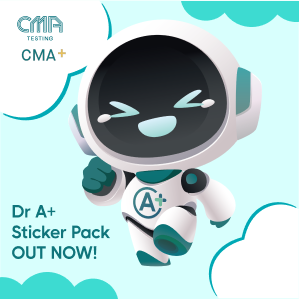
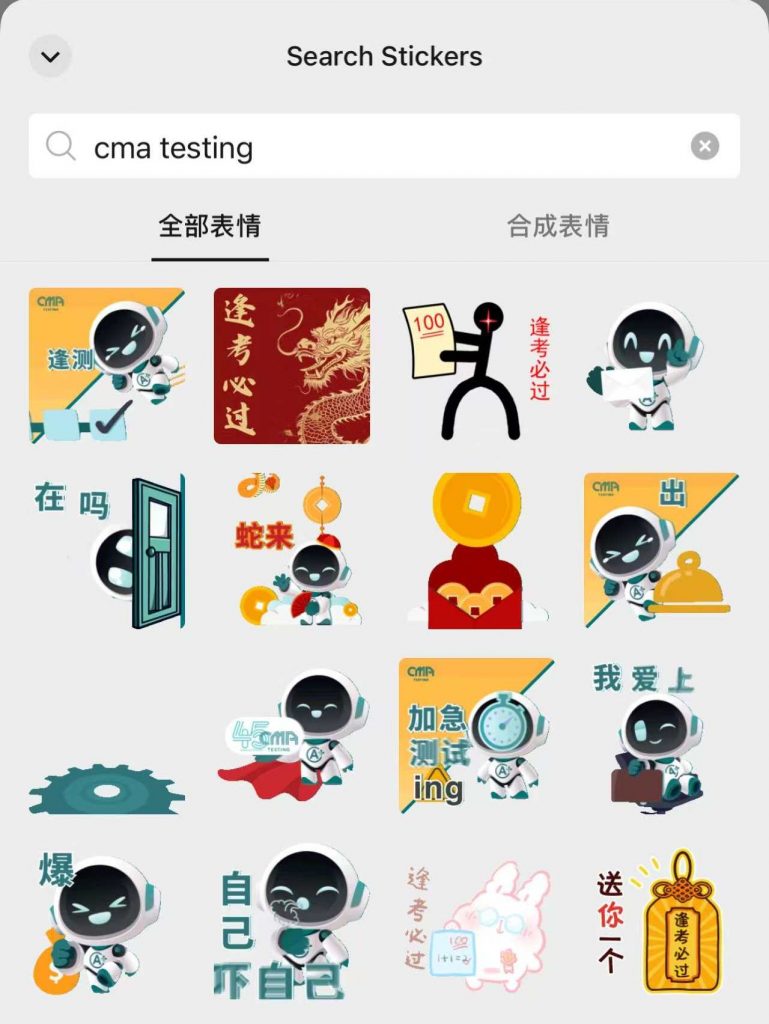
To celebrate the Chinese New Year, CMA+ have created a set of Dr A+ sticker packs for you to send well wishes to your family, friends, and clients. While nothing beats face-to-face engagement, it’s also hot and fun to share Chinese New Year stickers via Wechat! Download the Dr A+ sticker pack now to boost more innovation and fun during the festival!
How to download?
Method One:

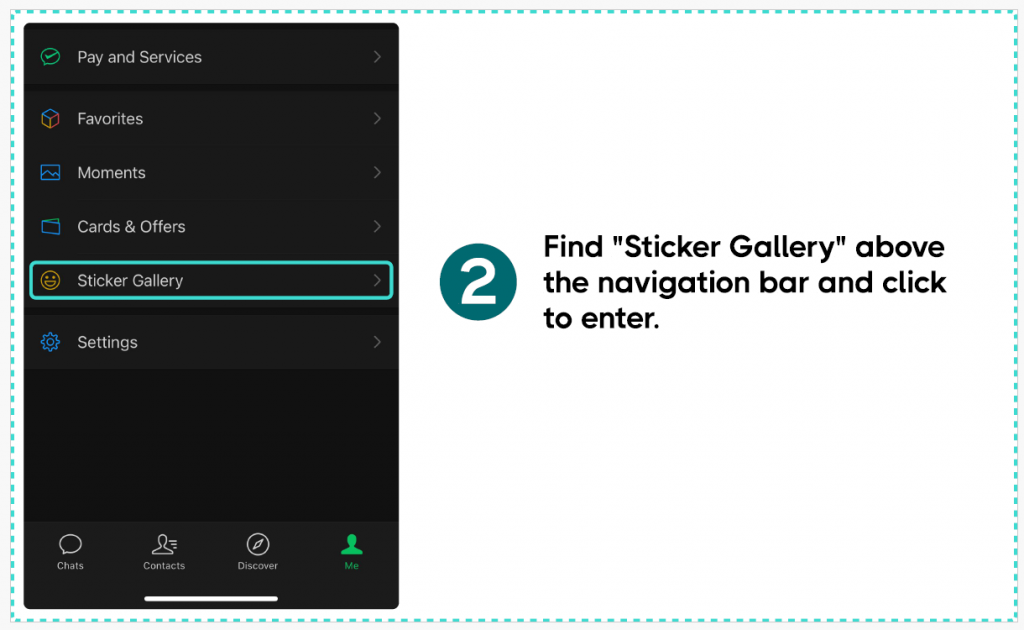
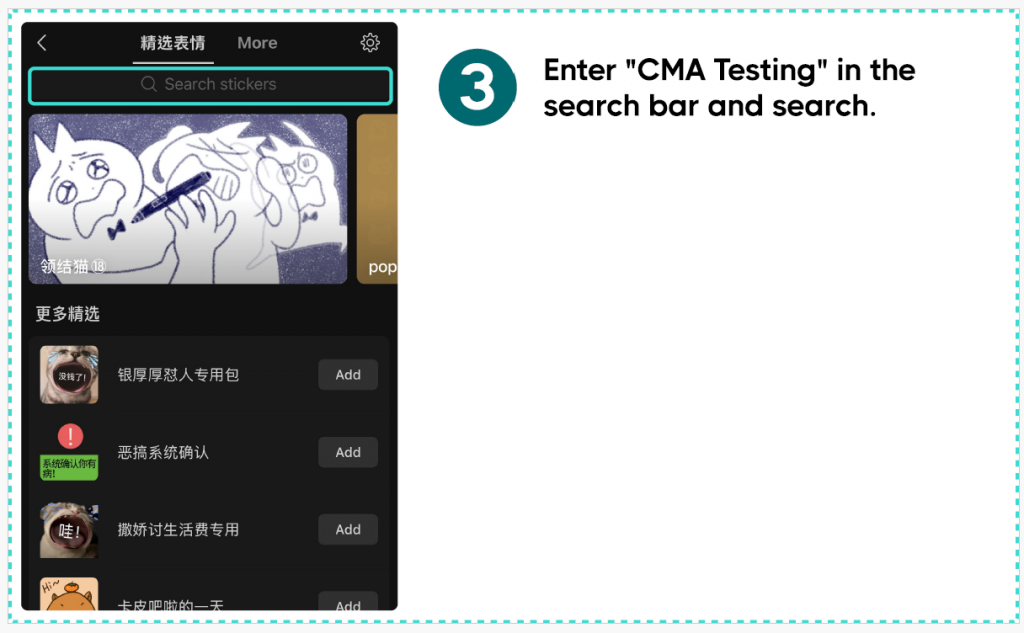
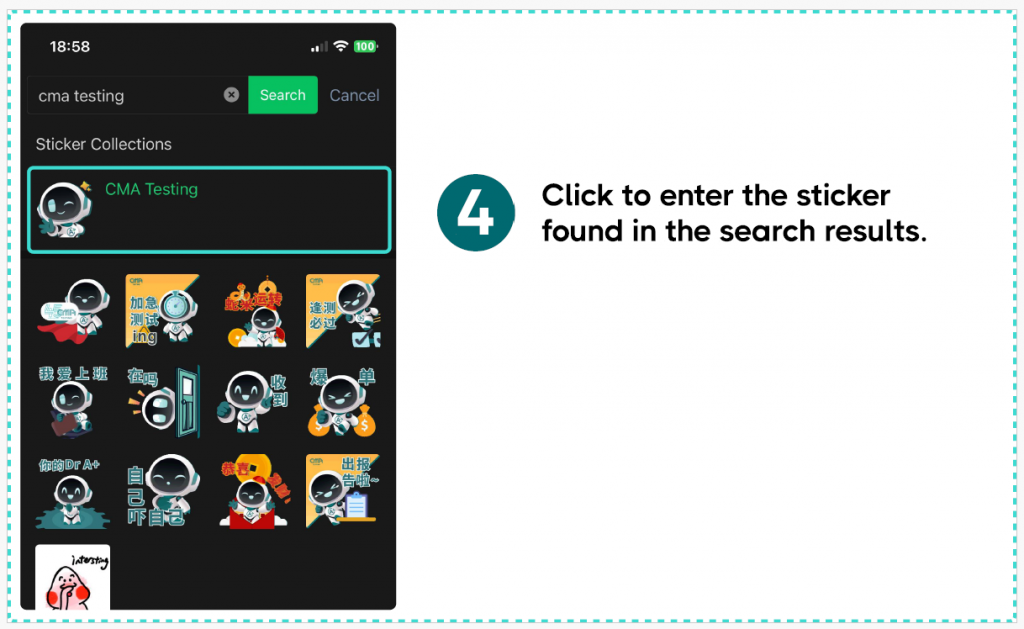


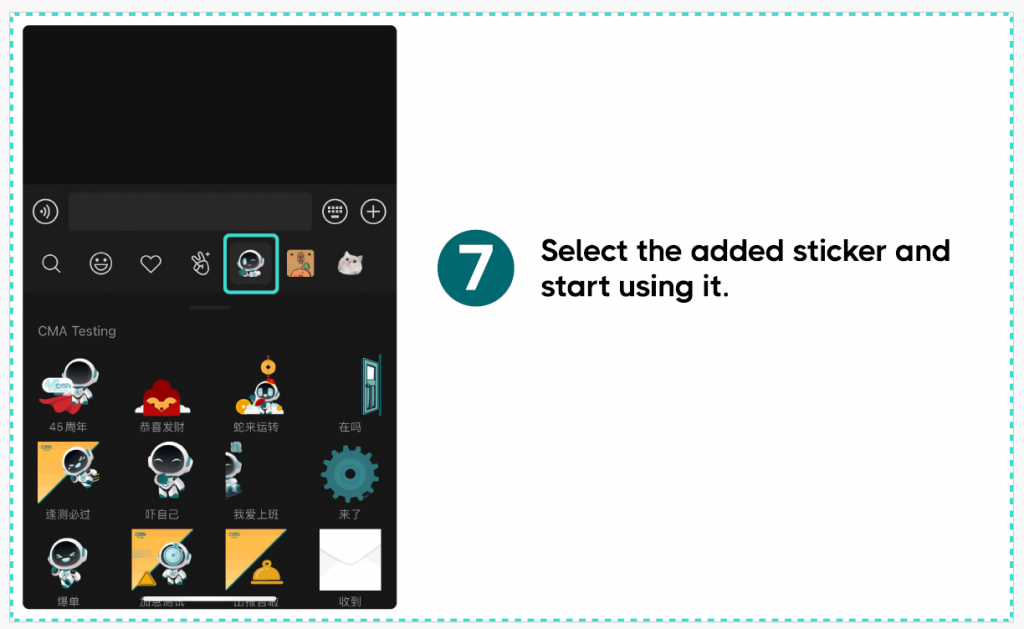
Method Two:
Acquisition Method 2
If you are using the Wechat International app, we recommend that you can select the emoji icon in any chat conversation and use its search function to search for “CMA Testing” to display it.
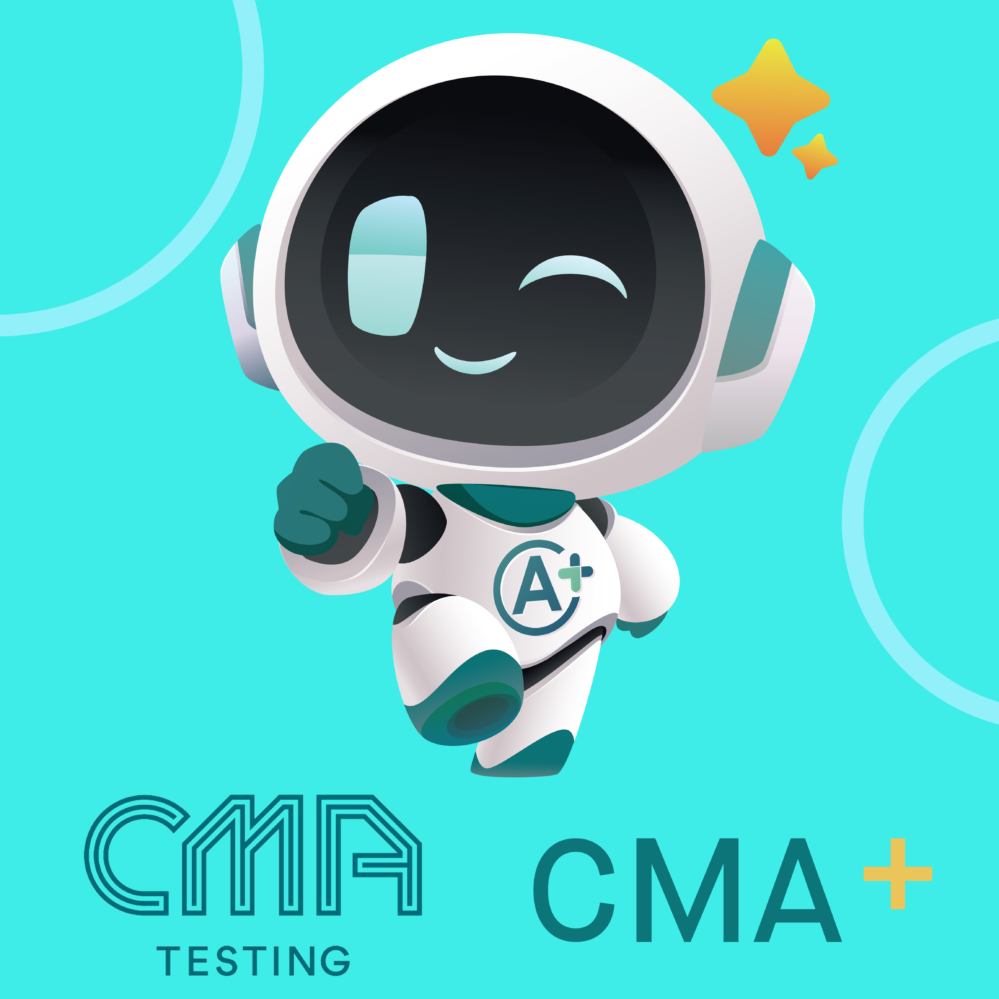
Greetings, everyone! We, at CMA Testing and CMA+, are pleased to take this opportunity to introduce our new team member to you, Dr A+! As a cutting-edge robot, Dr A+ is capable of working 24/7 tirelessly, embodying the characteristics of a workaholic, much like its pals at CMA+.
In the bustling world of technology and innovation, Dr A+ is dedicated to the pursuit of technology commercialisation, transforming aspirations into reality and making dynamic ideas available to all. With a strong commitment to education and support, Dr A+ diligently works to empower both individuals and organizations, ensuring that innovation transcends mere theory and turns research results into tangible tech solutions.
As an ideal inventor mentor, Dr A+ has a keen eye for potential and is dedicated to propelling your business forward. Whether you are launching a startup or aspiring entrepreneurs, Dr A+ is committed to catalyzing growth and success.
With a heart for collaboration and a mind for innovation, Dr A+ is not just a mascot but a symbol of hope and possibility in the ever-evolving landscape of technology.

1.CPSC approves to implement eFiling for certificates of compliance
On December 18, 2024, the U.S. Consumer Product Safety Commission (CPSC) has approved a Final Rule to implement electronic filing (eFiling) of Certificate information for regulated, imported consumer products and to revise requirements for Certificates of Compliance. The Commission vote was 3-0-2, with all five Commissioners voting to approve the rule; and a majority voting to approve the rule with an amendment extending the general implementation date from 12 months to 18 months. Under the new rule, requirements impacting most imported consumer products and those produced domestically will take effect 18 months from publication in the Federal Register. A 24-month effective date will apply to consumer products imported into a Foreign Trade Zone1 (FTZ) and subsequently entered for consumption or warehousing.
2.EPA publishes a final rule to gradually ban trichloroethylene and perchloroethylene
- On December 9, 2024, the U.S. Environmental Protection Agency (EPA) published the final rule under the Toxic Substances Control Act (TSCA) to ban all uses of trichloroethylene (TCE) within one year, including TCE manufacture and processing for most commercial and all consumer products. At the same time, EPA is finalizing a 10-year phase out for the use of and perchloroethylene (PCE) in dry cleaning to eliminate the risk to people who work or spend considerable time at dry cleaning facilities.
3.FDA proposes to require standardized testing methods for detecting and identifying asbestos in talc-containing cosmetic products
On December 26, 2024, the U.S. Food and Drug Administration (FDA) announced a proposed rule to establish and require standardized testing methods to detect and identify asbestos in talc-containing cosmetic products. This proposed rule, if finalized, will help protect consumers who use talc-containing cosmetic products from harmful exposure to asbestos. This proposal is part of the agency’s work to fulfill the requirements of section 3505 of the Modernization of Cosmetics Regulation Act of 2022 (MoCRA). The proposed rule would require to test for asbestos using an analytical approach that includes both Polarized Light Microscopy (PLM) (with dispersion staining) and Transmission Electron Microscopy (TEM)/Energy Dispersive Spectroscopy (EDS)/Selected Area Electron Diffraction (SAED) to detect and identify the presence of asbestos.
4.FDA announces a final guidance for industry entitled “Registration and Listing of Cosmetic Product Facilities and Products.”
On December 12, 2024, the U.S. Food and Drug Administration (FDA) announced a final guidance for industry entitled “Registration and Listing of Cosmetic Product Facilities and Products.”The guidance will assist persons submitting cosmetic product facility registrations and product listing submissions to FDA under the Modernization of Cosmetics Regulation Act of 2022 (MoCRA). This guidance includes three new draft frequently asked questions and answers about cosmetic product facility registrations and product listing submissions, in Appendix B, for comment purposes only. Aside from the three new draft frequently asked questions and answers, this guidance finalizes the draft Appendix B published in an otherwise final guidance on December 19, 2023. This guidance also includes minor changes to the final guidance for clarity.
5.OEHHA officially revises the short-form warning label under California Proposition 65
On December 9, 2024, The Office of Environmental Health Hazard Assessment (OEHHA) has amended Title 27, California Code of Regulations sections 25601, 25602, 25603, and 25607.2, and added new sections 25607.50 through 25607.53. The Office of Administrative Law (OAL) approved the rulemaking on November 26, 2024. The effective date for the regulation is January 1, 2025. This regulatory action will make the Proposition 65 short-form warning more informative to consumers by adding at least one chemical name and providing additional warning options for businesses to select from. The regulations provide businesses that currently rely on the existing short-form warnings three years to transition to the new short-form content, make explicit that short-form warnings may be used to provide safe harbor warnings for food products, provide a 60-day transition period, during the three-year implementation period for retailers to update online short-form warnings after notice from a manufacturer, and provide new tailored safe harbor warnings for passenger or off-highway motor vehicle parts and recreational marine vessel parts.
6.CEN releases a new version toy safety standard EN 71-3:2019+A2:2024
On December 4, 2024, the European Committee for Standardization (CEN) released a new toy safety standard EN 71-3:2019+A2:2024 “Safety of toys – Part 3: Migration of certain elements”. This standard is expected to be harmonized under Directive 2009/48/EC, the so-called Toy Safety Directive (TSD), upon official acceptance by the European Commission (EC) and by publication in the Official Journal of the European Union (OJEU). Other standards of conflict will be withdrawn by June 30, 2025 at the latest.
7.CEN releases the test methods for phenol and bisphenol A in toy materials.
On December18, 2024, the European Committee for Standardization (CEN) released two toy safety test standards: EN 71-18:2024 “Safety of toys – Part 18: Phenol in aqueous (content) and polymeric (migration) toy materials” and EN 71-19:2024 “Safety of toys – Part 19: Migration of bisphenol A from toy materials”. This two standards are applicable to toys intended for use by children under 36 months or other toys intended to be placed in the mouth. EN 71-18:2024 and EN 71-19:2024 are planned to be given the status of national standards in CEN member countries, and any conflicting standards will be withdrawn by June 30, 2025 at the latest.
8.EU updates toy guidance documents
The EU updated guidance document No 13 on craft kits on November 18, 2024 and guidance document No 20 on decorative products and products for collectors on November 21, 2024.
https://ec.europa.eu/docsroom/documents/63076
https://ec.europa.eu/docsroom/documents/63075
9.ECHA announces addition of six substances to SVHC Candidate List in January 2025
The European Chemicals Agency (ECHA) has taken significant steps to strengthen chemical safety regulations. During its December meeting, the Member State Committee (MSC) identified Octamethyltrisiloxane as a Substance of Very High Concern (SVHC). Additionally, four other substances were approved for inclusion in the Candidate List via written procedure, and one substance will be added automatically without MSC involvement.
Six substances of very high concern will be added in January 2025 to the Candidate List:
- Octamethyltrisiloxane (EC 203-497-4, CAS 107-51-7)
- O,O,O-triphenyl phosphorothioate (EC 209-909-9, CAS 597-82-0)
- Reaction mass of: triphenylthiophosphate and tertiary butylated phenyl derivatives (EC 421-820-9, CAS 192268-65-8)
- Perfluamine (EC 206-420-2, CAS 338-83-0)
- Tris(4-nonylphenyl, branched and linear) phosphite
- 6-[(C10-C13)-alkyl-(branched, unsaturated)-2,5-dioxopyrrolidin-1-yl] hexanoic acid (EC 701-118-1, CAS 2156592-54-8)
https://echa.europa.eu/-/highlights-from-december-member-state-committee-meeting
10.EU Regulation (EU) 2024/3190: A complete ban on bisphenol A in food contact materials
On December 31, 2024, the Official Journal of the European Union published Regulation (EU) 2024/3190, amending Regulation (EU) No 10/2011 for plastic food contact materials and articles and repealing Regulation (EU) 2018/213. This Regulation shall enter into force on the twentieth day following that of its publication in the Official Journal of the European Union. This regulation applies to adhesives, rubbers, ion-exchange resins, plastics, printing inks, silicones, varnishes and coatings. The main prohibitive requirements include:
- The use of BPA and its salts in the manufacture of food contact materials and articles is prohibited;
- Food contact materials and articles that have been manufactured using another bisphenol or bisphenol derivative shall not contain any residual BPA;
- The use of hazardous bisphenols other than BPA or hazardous bisphenol derivatives in the manufacture of food contact materials and articles is prohibited.
https://eur-lex.europa.eu/eli/reg/2024/3190/oj/eng
11.EU abandon the initiative to restrict MCCP and TBBP-A under the RoHS Directive
On December 10, 2024, the EU announced the abandonment of the initiative to add medium-chain chlorinated paraffins (MCCPs) and tetrabromobisphenol A (TBBP-A) restrictions to the RoHS Directive, meaning that companies producing electrical and electronic products do not need to adjust their compliance with MCCPs and TBBP-A for the time being. However, the EU also emphasized that feedback collected in the past is still available for future reference. However, the EU also emphasized that feedback collected in the past is still available for reference in the future.
12.35% of the SDS are found to be non-compliant in EU enforcement action
On December 3, 2024, inspectors in 28 EU-EEA countries checked over 2500 safety data sheets to enforce the new requirements introduced in 2023. ECHA’s Enforcement Forum found that 35 % of the checked safety data sheets (SDS) were non-compliant. Compliance has improved compared to earlier enforcement projects, but more efforts are needed to further enhance the quality of information to better protect workers, professional users and the environment from risks posed by hazardous chemicals.
https://www.echa.europa.eu/-/compliance-of-safety-data-sheets-still-room-for-improvement
13.EU proposes to revise CMR lists under REACH Regulation
On December 5, 2024, the European Union released a revised draft act of the REACH Regulation (EC) No 1907/2006, proposing to revise as regards carcinogens, germ cell mutagens or reproductive toxicants (CMR) subject to restrictions. The draft act aims to protect consumers by adding newly classified CMR substances to the lists of CMR substances restricted for consumer use under REACH Regulation. This draft act is open for feedback from December 5, 2024 to January 2, 2025.
14.UK releases a guidance document on the implementation of GPSR in Northern Ireland
On December 3, 2024, the UK released a guidance relates to the European Union (EU) Regulation on General Product Safety 2023/988 (GPSR). This Regulation applies directly in respect of Northern Ireland (NI) from 13 December 2024. GPSR sets out the requirement that consumer products must be safe, the responsibilities of relevant Market Surveillance Authorities (MSAs), and requirements for the sharing of product safety information. This guidance provides an overview of the Regulation primarily for MSAs operating in NI.
15.UK revises the lists of prohibited and restricted ingredients in cosmetic
On December 17, 2024, UK published the Cosmetic Products (Restriction of Chemical Substances) (No. 2) Regulations 2024, amending UK Regulation (EC) No 1223/2009 to prohibit or restrict the use of certain substances in cosmetic products. The Regulation come into force on 31st January 2025.
https://www.legislation.gov.uk/uksi/2024/1334/made
16.Canada publishes Regulations amending the Formaldehyde Emissions from Composite Wood Products Regulations
On December 9, 2024, Canada published the SOR/2024-256 to revise the SOR/2021-148 “Formaldehyde Emissions from Composite Wood Products Regulations” in the Canada Gazette. These Regulations come into force on the 90th day after the day on which they are published in the Canada Gazette.
The Amendments:
- Provide clarity for regulated parties and reduce the risk of misapplication of the regulations by removing the accreditation requirement for laboratories conducting routine quality control formaldehyde emissions testing;
- Revise record-keeping requirements for all entities along the composite wood products supply chain to reduce unintended burden;
- Maintain the regulations’ close alignment with TSCA Title VI in order to minimize international trade barriers; and
- Make minor amendments to provide clarification on issues brought forward by stakeholders.
https://canadagazette.gc.ca/rp-pr/p2/2024/2024-12-18/html/sor-dors256-eng.html
17.Australia adds 3 new persistent organic pollutants
On December 2, 2024, Australian Department of Climate Change, Energy, the Environment and Water issued Industrial Chemicals Environmental Management (Register) Amendment (2024 Measures No. 2) Instrument 2024, adding three persistent organic pollutants (POPs), namely polychlorinated biphenyls, hexachlorobenzene, and polychlorinated terphenyls in Schedule 7 of Industrial Chemicals Environmental Management (Register) Instrument 2022. The new requirements will be implemented from July 1, 2025.
https://www.legislation.gov.au/F2024L01577/asmade/text
18.The State Administration for Market Regulation approves and releases 243 recommended national standards, including “Sulphuric acid for industrial use”
On December 31, 2024, China’s State Administration for Market Regulation (National Standardization Administration) published Announcement (No. 32 of 2024) approving release of 243 recommended national standards, including “Sulphuric acid for industrial use”. Among these, GB/T 29292-2024 “Footwear—Guidelines for the management and control of key chemicals in footwear and footwear components” will take effect on July 1, 2025, and GB/T 3920-2024 “Textiles—Tests for colour fastness—Colour fastness to rubbing” will take effect on January 1, 2027.
https://std.sacinfo.org.cn/gnoc/queryInfo?id=D70C7776CA26345187444B57A6EEA86C
Recall
EU rapid alert system for dangerous non-food products (Rapex):
https://ec.europa.eu/safety-gate-alerts/screen/search?resetSearch=true
Canada Recall:
https://recalls-rappels.canada.ca/en/search/site
Australian Recall:
https://www.productsafety.gov.au/recalls
US CPSC Recall:
Recall case:
| Product category | Sample images | Notification submitted by | Reason for recall |
|---|---|---|---|
| Bluetooth Speakers |   | US Canada | The lithium-ion batteries in the recalled Bluetooth Speakers can overheat, posing a fire hazard. |
| High Bay LED light fixtur |  | US | The plastic pins securing the LED light fixture can degrade, allowing the electrically charged LED board to come loose and contact items nearby that can catch fire, posing a fire hazard. |
| Oven Gloves |  | US | The oven gloves can fail to provide sufficient protection from heat, posing a burn hazard to consumers. |
| Fast Wireless Charger Power Banks 10K |  | US Canada | The lithium-ion batteries in the recalled power banks can overheat, posing a fire hazard. |
| Travel mugs |   | US | These mug’s lid threads can shrink when exposed to heat and torque, causing the lid to detach during use, posing a burn hazard. |
| Wall Teester Bed Crowns |  | US | The welded metal tabs used to mount the recalled bed crowns can weaken, causing the bed crown to fall from the wall onto consumers below, posing an injury hazard. |
| Mini speakers |  | US/Canada | The speaker’s lithium-ion battery can overheat and catch fire, posing burn and fire hazards to consumers. |
| Battery chargers |  | US | The chargers can ignite or cause a connected battery to ignite, posing fire and burn hazards and risk of serious injury and death. |
| Wireless Decorative Tree Light Controllers |  | US | The wireless receiver that plugs into an outlet can overheat, posing a fire hazard. |
| Magnetic Building Sticks Sets |  | US | The recalled magnetic building sticks set violates the mandatory federal regulation for magnet toys posing an ingestion hazard. When high-powered magnets are swallowed, the ingested magnets can attract each other, or another metal object, and become lodged in the digestive system. This can result in perforations, twisting and/or blockage of the intestines, infection, blood poisoning and death. |
| Silicone spoons for babies |  | US | The silicone spoon can break apart while in use, posing a choking hazard to babies. |
| 40V 5.0 Ah Lithium-Ion Batteries |  | US/Canada | The lithium-ion batteries can overheat, posing fire and burn hazards. |
| Power banks, |  | US | The lithium-ion battery in the recalled power banks can overheat and ignite, posing fire and burn hazards to consumers. |
| Drawer Dressers |  | US | The recalled dressers are unstable if they are not anchored to the wall, posing serious tip-over and entrapment hazards that can result in injuries or death to children. The dressers violate performance and warning label requirements of the STURDY Act. |
| Bath toy A12/03458/24 |  | Hungary | Small plastic parts (squeaking element) can easily detach from the toy. A small child may put them in the mouth and choke. The product does not comply with the requirements of the Toy Safety Directive, nor with the European standard EN 71-1. |
| Bath toy A12/03655/24 |  | Austria | The toy has a small part (the flipper) which can easily detach. A small child may put it in the mouth and choke. The product does not comply with the requirements of the Toy Safety Directive nor with the European standard EN 71-1. |
| Soft toy A11/00159/24 |  | Germany | The zip fastener allows access to the stuffing material. A child may put the filling material in the mouth and choke. The product does not comply with the requirements of the Toy Safety Directive nor with the European standard EN 71-1. |
| Soft toy A11/00156/24 |  | France | The fibrous stuffing material of the toy is easily accessible due to the weakness of the seams. A small child may put the filling material in the mouth and choke. The product does not comply with the requirements of the Toy Safety Directive nor with the European standard EN 71-1. |
| Baby book A12/03444/24 |  | Germany | The product has small parts, (the glued eyes, the pointer snap-fit fastener and the collar with snap hook) that can be easily detached. A small child may put them in the mouth and choke. The product does not comply with the requirements of the Toy Safety Directive nor with the European standard EN 71-1. |
| Baby book A12/03435/24 |  | Germany | The product has small parts (the eyes, snap fasteners, neck-band eye and beads) that can be easily detached. A small child may put them in the mouth and choke. The product does not comply with the requirements of the Toy Safety Directive nor with the European standard EN 71-1. |
| Plastic toy A12/03647/24 |  | Poland | The toy may break easily generating small plastic parts. A child may put them into mouth and choke. The product does not comply with the requirements of the Toy Safety Directive nor with the European standard EN 71-1. |
| Plastic toy A12/03661/24 |  | Austria | The product has small parts (the suction cups). A small child can put them in the mouth and choke. The product does not comply with the requirements of the Toy Safety Directive nor with the European standard EN 71-1. |
| Plastic toy set SR/03744/24 |  | Lithuania | The toy set contains small parts (foam balls). A small child may put them in the mouth and choke. The product does not comply with the requirements of the Toy Safety Directive nor with the European standard EN 71-1. |
| Set of toy cars A12/03642/24 |  | France | The product has a small part (wheel) which can easily detach. A small child may put it in the mouth and choke. The product does not comply with the requirements of the Toy Safety Directive nor with the European standard EN 71-1. |
| Toy train SR/03812/24 |  | Slovenia | The product can easily break, resulting in small parts (train roof). A small child may put them in the mouth and choke. The product does not comply with the requirements of the Toy Safety Directive nor with the European standard EN 71-1. |
| Toy dog SR/03765/24 | 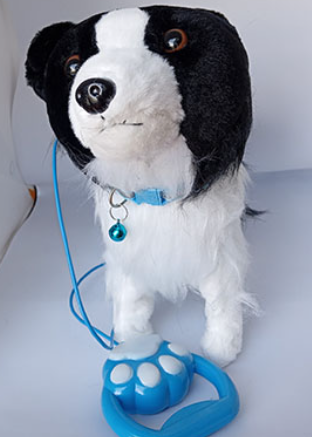 | Lithuania | The collar of the toy dog can easily break, resulting in small parts (the collar bell). A small child may put them in the mouth and choke. The product does not comply with the requirements of the Toy Safety Directive nor with the European standard EN 71-1. |
| Toy wands A12/03665/24 |  | France | The handle of the wand can be easily break, making the button batteries inside accessible. A child may put them in the mouth, which could cause them to choke, or they can be swallowed, which could cause damage to the child’s gastrointestinal tract. The product does not comply with the requirements of the Toy Safety Directive nor with the European standard EN 62115. |
| Toy slime SR/03719/24 |  | Lithuania | The migration of boron from the toy slime is too high (measured value up to 580 mg/kg). Ingestion or contact with an excessive quantity of boron may harm the health of children by damaging their reproductive system. The product does not comply with the requirements of the Toy Safety Directive nor with the European standard EN 71-3. |
| Toy slime INFO/00135/24 |  | France | The migration of boron from the toy slime is too high (measured value: 300 mg/kg). Ingestion or contact with an excessive quantity of boron may harm the health of children by damaging the reproductive system. The product does not comply with the requirements of the Toy Safety Directive nor with the European standard EN 71-3. |
| Toy slime A12/03608/24 |  | Slovakia | The migration of boron from the toy slime is too high (measured value: 550 mg/kg). Ingestion or contact with an excessive quantity of boron may harm the health of children by damaging their reproductive system. The product does not comply with the requirements of the Toy Safety Directive nor with the European standard EN 71-3. |
| Plastic doll set A12/03456/24 |  | Hungary | The product has an excessive concentration of di-2-ethylhexyl phthalate (DEHP) and dibutyl phthalate (DBP): (measured values: 0.74% and 17% by weight). These phthalates may harm the health of children, causing possible damage to their reproductive system. The product does not comply with the REACH Regulation. |
| Plastic doll A12/03479/24 |  | Hungary | The product has an excessive concentration of bis(2-ethylhexyl) phthalate (DEHP) and dibutyl phthalate (DBP) (measured values: 0.38% and 0.64% by weight, respectively). These phthalates may harm the health of children, causing possible damage to their reproductive system. The product does not comply with the REACH Regulation. |
| Plastic doll A12/03481/24 |  | Hungary | The product has an excessive concentration of bis(2-ethylhexyl) phthalate (DEHP) and dibutyl phthalate (DBP) (measured values: 20% and 0.51% by weight, respectively). These phthalates may harm the health of children, causing possible damage to their reproductive system. The product does not comply with the REACH Regulation. |
| Plastic doll SR/03830/24 |  | Czechia | The product contains an excessive amount of di-2-ethylhexyl phthalate (DEHP) (measured value: 24% by weight) and Dibutyl phthalate (DBP): (measured value: 0.22% by weight). These phthalates may harm the health of children, causing possible damage to their reproductive system. The product does not comply with the REACH Regulation. |
| Plastic toy A12/03488/24 |  | Poland | The plastic material of the product has an excessive concentration of dibutyl phthalate (DBP) and diisobutyl phthalate (DIBP) (measured values: up to 12.4% and 1.91% by weight respectively). These phthalates may harm the health of children, possibly by causing damage to the reproductive system. The product does not comply with the REACH Regulation. |
| Toy mobile phone A12/03361/24 |  | Czechia | The product has excessive concentrations of lead and cadmium (measured values up to 79.1 % and 0.26% by weight, respectively). The product does not comply with the requirements of RoHS Directive. |
| Flashlight A12/03496/24 |  | Sweden | The plastic material of the cable has excessive concentrations of bis(2-ethylhexyl) phthalate (DEHP), dibutyl phthalate (DBP) and short chain chlorinated paraffins (SCCPs) (measured values: up to 0.46%, 0.23% and 2.0% by weight, respectively). The product does not comply with the requirements of RoHS Directive, nor with POP Regulation. |
| Smartwatch A12/03449/24 |  | Sweden | The solders in the product have an excessive concentration of cadmium (measured value up to 0.5 % by weight). The product does not comply with the requirements of RoHS Directive. |
| Headphones SR/03823/24 |  | Sweden | The product has excessive concentrations of lead in the plastic cable and in solders (measured value up to 79.9 % by weight). The product also has DBP and DEHP in excessive concentrations (measured values up to 0.8 and 3.07 % by weight respectively). Furthermore, the product has an excessive concentration of short-chain chlorinated paraffins (SCCPs) (measured value up to 56.2 % by weight The product does not comply with the requirements of RoHS Directive, nor with POP Regulation. |
| Handheld magnifier SR/03820/24 |  | Sweden | The solders in the product have an excessive concentration of lead (measured value up to 66 % by weight). The product does not comply with the requirements of RoHS Directive. |
| Inflatable swim seat SR/03809/24 |  | Cyprus | The product may resemble a toy; however, there is a risk of drowning if children play with it unsupervised. Floating seats must be used under constant adult supervision. Moreover, product usage information and warnings are inadequate. The product does not comply with the requirements of the General Product Safety Directive nor with the European standard EN 13138. |
| Chair A12/03501/24 |  | Lithuania | Due to incorrect design of the chair, the user can fall and suffer injuries. The product does not comply with the requirements of the General Product Safety Directive nor with the European standard EN 12520. |
| Children’s hoodie A12/03670/24 |  | Italy | The product has functional cords close to the neck area. The cords may become trapped during various activities of a child, leading to strangulation. The product does not comply with the requirements of the General Product Safety Directive nor with the European standard EN 14682. |
| Children’s hoodie A12/03432/24 |  | Cyprus | The hoodie has drawstrings close to the neck area, which may become trapped during various activities of a child, leading to strangulation. The product does not comply with the requirements of the General Product Safety Directive nor with the European standard EN 14682. |
| Glasses case SR/03738/24 |  | France | The product has an excessive concentration of formaldehyde (measured value: 146 mg/kg). Formaldehyde is a skin sensitizer and can trigger allergic reactions and may cause cancer. The product does not comply with the REACH Regulation. |
| Novelty lighter SR/03726/24 |  | Czechia | The lighter is appealing to children due to its shape and colour. Children may play with it and suffer burns or cause a fire. The product does not comply with the requirements of the General Product Safety Directive nor the European standard EN 13869. |
| Napkin ring A12/03399/24 |  | Sweden | The plastic material of the product has an excessive concentration of bis(2-ethylhexyl) phthalate (DEHP) (measured value up to 13 % by weight). The product does not comply with the REACH Regulation. |
As we welcome the Year of the Snake, CMA Testing would like to extend our heartfelt wishes for a prosperous and joyous Chinese New Year to you and your family.
May this festive season bring you good health, happiness, and success in all your endeavors.
CMA Testing Chinese New Year holiday notice:
Head Office:
Please be informed that HKO will be closed from 29 Jan to 4 Feb 2025 and operations will be resumed on 5 Feb 2025.
Shenzhen:
Please be informed that SZO will be closed from 25 Jan to 4 Feb 2025 and operations will be resumed on 5 Feb 2025.
Shanghai:
Please be informed that SHO will be closed from 28 Jan to 2 Feb 2025 and operations will be resumed on 3 Feb 2025.
Sorry for any inconvenience caused. Happy Chinese New Year!

Amid the wave of globalization, cross-border e-commerce platforms are facing unprecedented opportunities and challenges! CMA Testing is proud to announce its official partnership with Temu, offering professional product testing and certification services to cross-border merchants, helping their products successfully enter international markets!

As a globally leading testing and certification organization, CMA Testing is committed to technological excellence and efficient service, providing comprehensive testing solutions for various consumer products, including but not limited to:
- Quality Testing: Ensuring products meet international standards and providing consumers with premium choices
- Safety Certification: Ensuring compliance with international regulations, giving merchants peace of mind for exports
- Global Reach: Leveraging CMA Testing’s worldwide service network to help merchants expand into more regions
Partnering closely with Temu, CMA Testing is committed to providing fast, secure, and professional services, helping merchants expand globally and embrace new opportunities in cross-border e-commerce!
We will continue to empower cross-border merchants with professionalism and innovation, creating new business value together!

Recently, CMA Testing received the 2024 textile antimicrobial performance inter-laboratory comparison results from the Zhongguancun Huizhi Antibacterial New Materials Industry Technology Innovation Alliance, with satisfactory results, demonstrating the laboratory’s strong microbiological testing capabilities.
CMA Testing has an experienced microbiological testing team offering professional services in food, water, textiles, cosmetics, and more. We welcome inquiries for testing and certification cooperation.
CMA/CNAS Microbiological Accreditation
| Category | Regulation | Testing Items |
| Food | GB4789 series | Aerobic plate count, Coliform Bacteria, Molds and Yeasts, Salmonella, Staphylococcus aureus, Vibrio parahaemolyticus, Escherichia coli, Escherichia coli O157:H7/NM |
| Drinking Water | GB/T 5750.12 | Standard Plate-count Bacteria, Total Coliforms, Thermotolerant coliform bacteria, Escherichia coli (E. coli) |
| Disinfection of dinner and drinking set, Food Contact Paper | GB 14934 | Coliform Bacteria, Salmonella, etc. |
| Disposable Sanitary Product | GB 15979 | The Total Number of Bacterial Colonies & Bioburden, Coliform Bacteria, Pseudomonas aeruginosa, Staphylococcus aureus,Streptococcus hemolyticus, Total Number of Fungal Colonies, Qualitative Detection of Fungal |
| Textiles | FZ/T 73023, GB 20944 series | Antibacterial effectiveness, Dissolution of Antimicrobial substances, Antibacterial (or bacteriostatic) |
| Cosmetics | Safety and Technical Standards for Cosmetics | Aerobic Bacterial Count, Thermotolerant Coliform Bacteria, Pseudomonas aeruginosa, Staphylococcus aureus, Molds and Yeast Count |
| Toys | USP 51 USP 61&62 FDA BAM Chapter 6 | Antimicrobial Effectiveness Testing; The Total Aerobic Microbial Count (TAMC), The Total Combined Yeasts and Molds Count (TYMC), , Bile-Tolerant Gram-Negative Bacteria, Escherichia coli, Salmonella, Pseudomonas aeruginosa, Staphylococcus aureus, Clostridia, Candida albicans, etc. Shigella |

CMA+ is committed to assisting scientific research institutions in developing new technologies and by connecting traditional industries, using innovative technologies to support enterprise upgrading and transformation, and realize Hong Kong’s vision of “new industrialization”. CMA+ also cooperates with scientific research institutions in different regions to activate the development of new technologies locally and overseas.
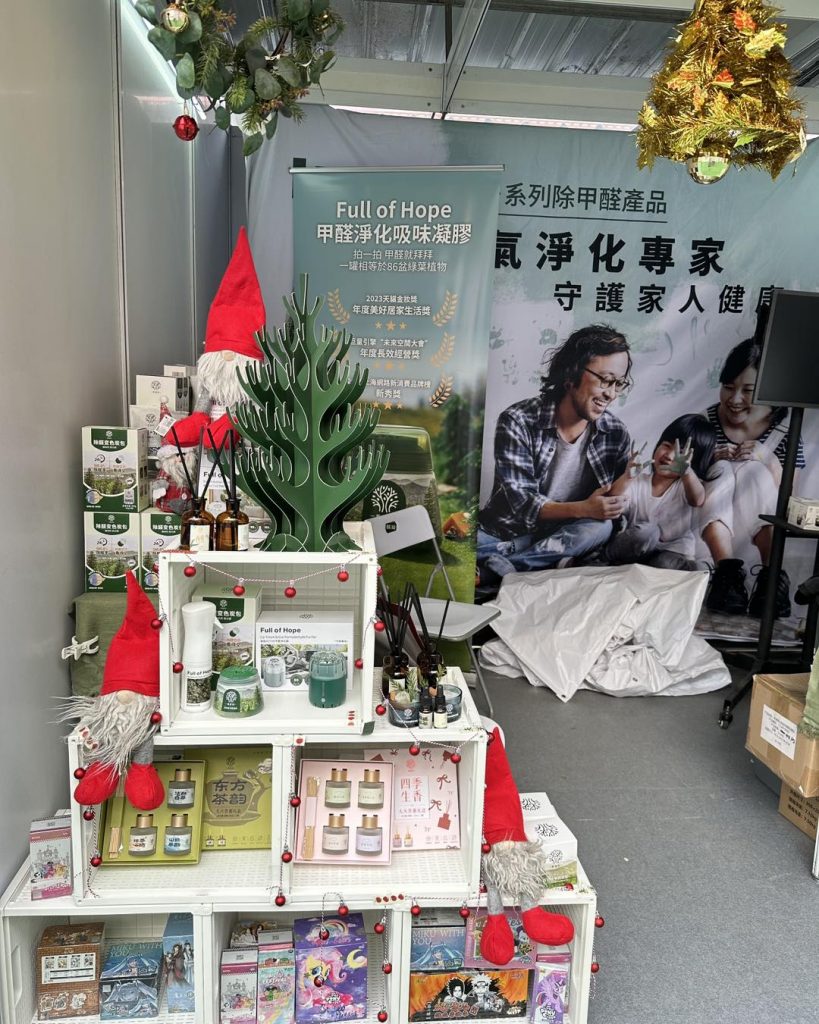
CMA+ and “Full of Hope”, will jointly display the successful products – aldehyde removal products at the 58th Hong Kong Industrial Fair. Please visit our booth 6B09 for purchasing.
“Full of Hope” website : https://www.fullofhope.cn/sy


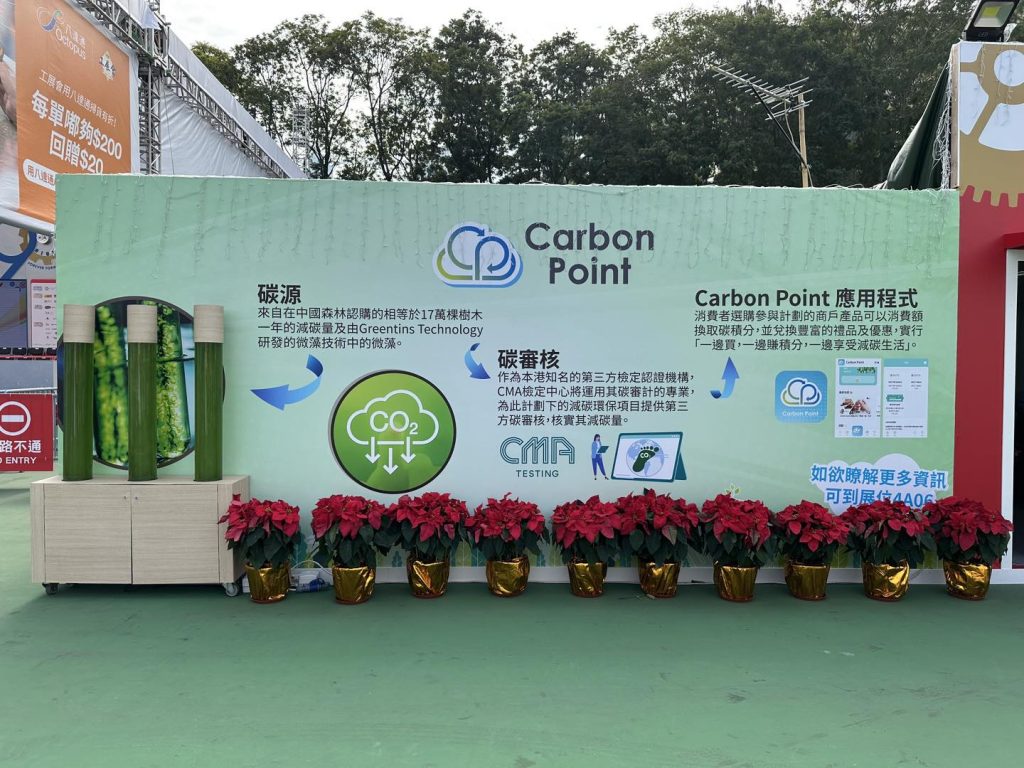
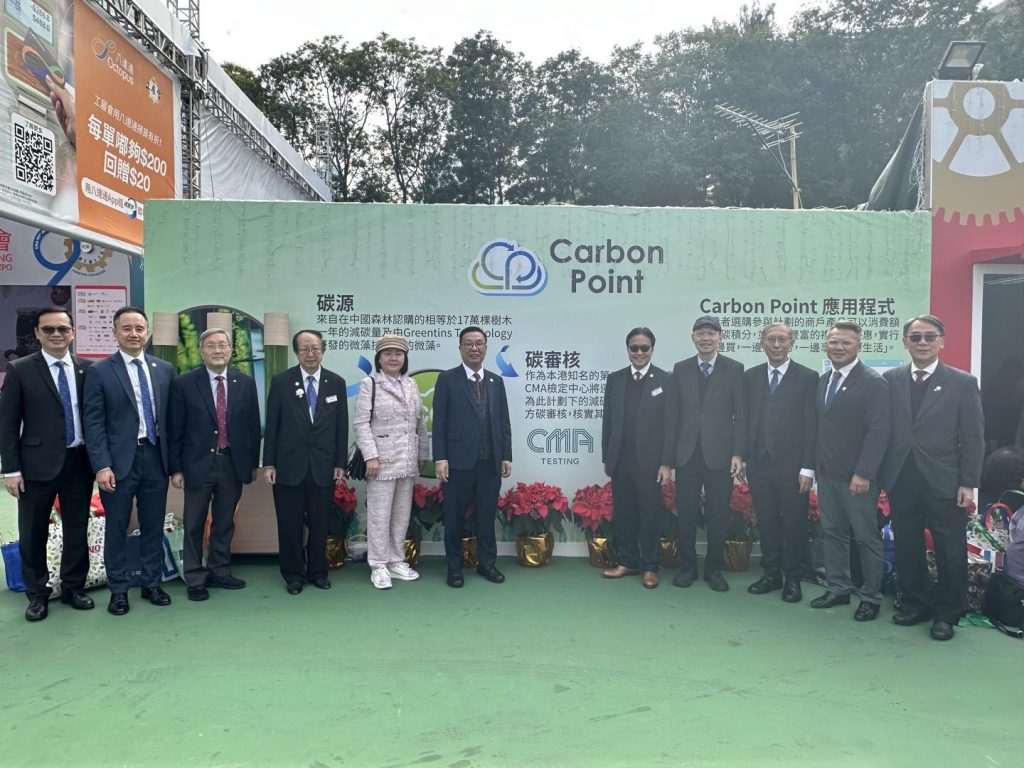
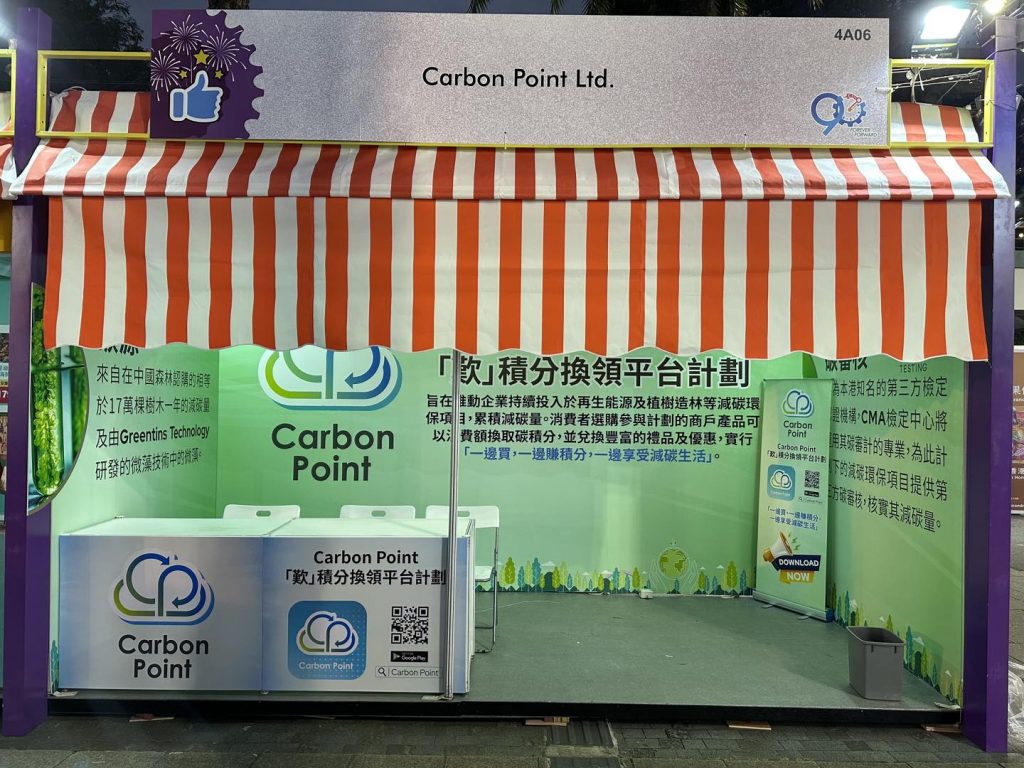
In order to stimulate Green Consumption in Hong Kong, CMA Testing and Carbon Points Limited joint force to deliver the first Green Consumption Apps in The 58th Hong Kong Brands & Products Expo. Please visit us at Booth 4A06 to learn how to exchange your special offer by Green Consumption and you can directly download the Apps by our QR code.