










Key Points
- Fire events in Hong Kong exposed safety gaps, leading to strict flammability requirements for upholstered furniture in public premises.
- FSD Circular No. 1 (2000) mandates compliance with BS 7176 and proper labeling/test reports.
- Updated BS 7176:2007+A1:2011 adds mandatory ignitability testing for each filling material, addressing risks missed by the 1995 version.
- Only the new version is internationally valid, and more government buyers already require it, pushing the industry toward enhanced fire safety.
When you go to restaurants, theaters or hotels, you will notice that the upholstered chairs will have the following label (Figure 1) to indicate that the upholstered chairs have complied with the fire safety standards.

(Figure 1)
The recent fire event echoes the another fire event in 1996 exposing similar vulnerabilities in aging structures, including inadequate fire-fighting equipment, flammable renovation materials, and interior furnishings like upholstered furniture, carpets, and curtains. The 1996 event directly prompted the Hong Kong government to enact stringent flammability regulations for such items in licensed premises and public areas.
In 2000, the Fire Services Department published “Fire Services Department Circular No. 1 of 2000, Flammability Standards for Polyurethane Latex Mattress and Upholstered Furniture in Licensed Premises and Public Places” (Ref. 1), requiring The flammability standards for polyurethane latex mattresses and fixed and removable upholstered furniture used in licensed premises and public places are excerpted for upholstered furniture as follows:
Upholstered furniture is required to comply with BS 7176:1995 (Ref. 2) for fire resistance testing of composite seats for non-domestic use (moderate hazard premises/buildings) or equivalent international standards.
The use of polyurethane foam filled furniture that meets the specified standards in licensed premises and public places shall have an appropriate label (as shown in Figure 1), the invoice with accredited test report issued by an accredited laboratory must be submitted by relevant manufacturer/suppliers to relevant department officer for checking.
The following (Table 1) is a summary of BS 7176: 1995 (Medium Hazard Premises/Buildings)
| BS 7176:1995 Specification | Application |
| Resistant to ignition source: smouldering cigarette of BS EN 1021-1 : 1994. Resistant to ignition source: match flame equivalent of BS EN 1021-2 : 1994. Resistant to ignition source 5 in section 4 of BS 5852 : 1990. | Hotel bedrooms Public buildings Restaurants Services’messes Places of public entertainment Public halls Public houses and bars Casinos Hospitals Hostels |
To understand this standard, you should firstly understand the ignition sources (Figure 2) and ignition methods (Table 2) of the British Standard Specifications, so that readers can easily understand:
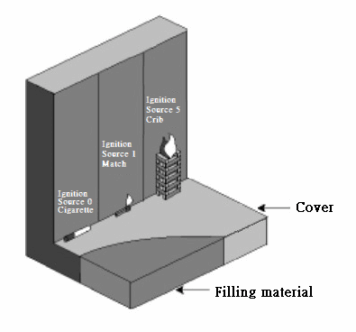
| Cigarette ignition test (Ignition source 0) | Match ignition test (Ignition source 1) | Wooden crib ignition test (Ignition source 5) |
 |  |  |
| After the sample has been pre-conditioned and maintained at constant temperature and humidity, place one of the customer’s fillings vertically and horizontally on the test rack and wrap it with the submitted fabric sample. Place a standard cigarette on the junction between the vertical and horizontal fillings. Then ignite and observe. | After the sample has been pre-conditioned and maintained at constant temperature and humidity, place one of the customer’s fillings vertically and horizontally on the test rack and wrap it with the submitted fabric sample. Place a burner with specified gas flow and energy on the junction between the vertical and horizontal fillings. Then ignite and observe. | After the sample has been pre-conditioned and maintained at constant temperature and humidity, place one of the customer’s fillings vertically and horizontally on the test rack and wrap it with the submitted fabric sample. Place a standard wooden crib on the junction between the vertical and horizontal fillings. Then ignite and observe. |
Per BS 7176:1995, filling and covering fabrics (which treated with water soaking) assembled as composite materials in accordance with the standard are tested in accordance with the required methods listed in the table above. When the results of the cigarette, match and wooden crib ignition tests of the composite material are all “non-ignition”, then it meets the Medium Hazard requirements of BS 7176:1995.
To provide consumers with greater safety protection, BS 7176:1995 has been updated in different ways over the past 20 years, and the latest version is BS 7176:2007+A1:2011 (Ref. 3). The most important update to the specification is the addition of the ignition test for filling materials. All fillings used in upholstered chairs must be tested for individual fillings in accordance with the guidelines in the Annexes (A to E) of the standard. These annexes will direct you to the corresponding provisions of the UK Furniture and Furnishings (Fire) (Safety) Regulations 1988 (Ref. 5) for testing. This updated standard specification can only be concluded to comply with the requirements only if the ignitability test of the composite material covered with fabric wrapped filling and each of its filling materials yields a “non-ignition” result at the same time.
In terms of consumer protection, this updated version has indeed improved fire safety due to the above specifications; however, it has also increased the production and testing costs of manufacturers. They believe that if the composite material is “non-ignition”, the filling material does not necessarily require “Non-ignition”. It’s because the final upholstered furniture is in a composite state rather than a separate material, consumers will not directly contact and ignite the filling material individually during normal use, so they regard the ignitability test of the added filling material just as optional. According to statistics surveyed by CMA Testing from August 2007 to January 2026, only an average of 8% of BS7176 tests were requested in an updated version. From this data, it shows that local and mainland manufacturers have been in passive response. Unless buyers specify a new version of the test, they usually request the old version for this specification test. One of reasons for them to use the old version in local use is it’s still acceptable to apply the license in local public premises.
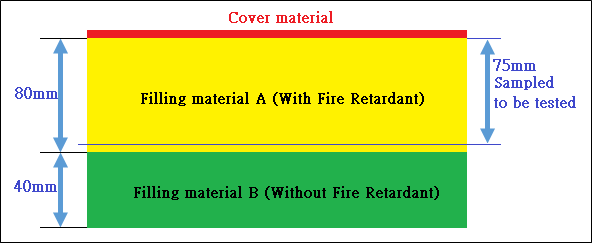
From a technical perspective, the old version (BS 7176:1996) test can only determine that when a single filling material is used in an upholstered chair, the composite material is “non-ignition” and the result is truly “non-ignition”. However, for upholstered chairs using two or above filling materials, when the composite filling material is composed of multiple layers and its total thickness exceeds 75 mm, the relevant test method standards BS5852:1990 (Ref. 5) or BS5852:2006 (Ref. 6) guides only the upper 75 mm of multi-layers filling material to be assembled with covering fabric for ignition testing.
Figure 3 below shows an upholstered chair with two filling materials (A with and B without fire retardant treatment) as an example, the thicker upper layer of filling material A was tested on a composite sample with a filling material thickness of 75±2 mm. The samples can be completely sampled from filling material A, but the filling material B in the lower layer without fireproof treatment has not been sampled and tested, which may lead to false “non-ignition” of the composite sample. Although the above situations are rare, in terms of safety risks, adopting the updated version of the test specification can remove the above limitations of the old version of the test and ensure that the fire safety of upholstered furniture is fully in place.
In terms of standard traceability, BS 7176:2007+A1:2011 has replaced the withdrawn BS 7176:1995 for many years and the withdrawn BS 7176:1995 has not been recognized internationally. Therefore, if there is a legal dispute, the court shall follow the effective standard BS 7176:2007+A1:2011. Hence, when the customer requires our laboratory to test BS 7176 without indicating the new or old version, we shall inform the customer of the above situation to confirm the new or old version to be followed for testing. At present, foreign buyers and some Hong Kong government departments have referred to the updated version of BS 7176:2007+A1:2011 as one of the receiving specifications in purchasing.
As we move forward, it is imperative that both local authorities and private stakeholders align their practices with updated flammability standards. The commitment to enhancing policy formulation, supervision, and law enforcement will play a crucial role in preventing similar fire events. A concerted effort to implement these guidelines will ensure a safer environment for all, fostering not only compliance but a culture of safety in commercial and public spaces. Together, we can work towards a future where such disasters are not just rare but entirely avoidable.
*** The End ***
Reference
Remark:
Due to the time in publishing, the regulation, standard and letter versions information stated above may be changed after the article composed date of 1 February 2026.
