











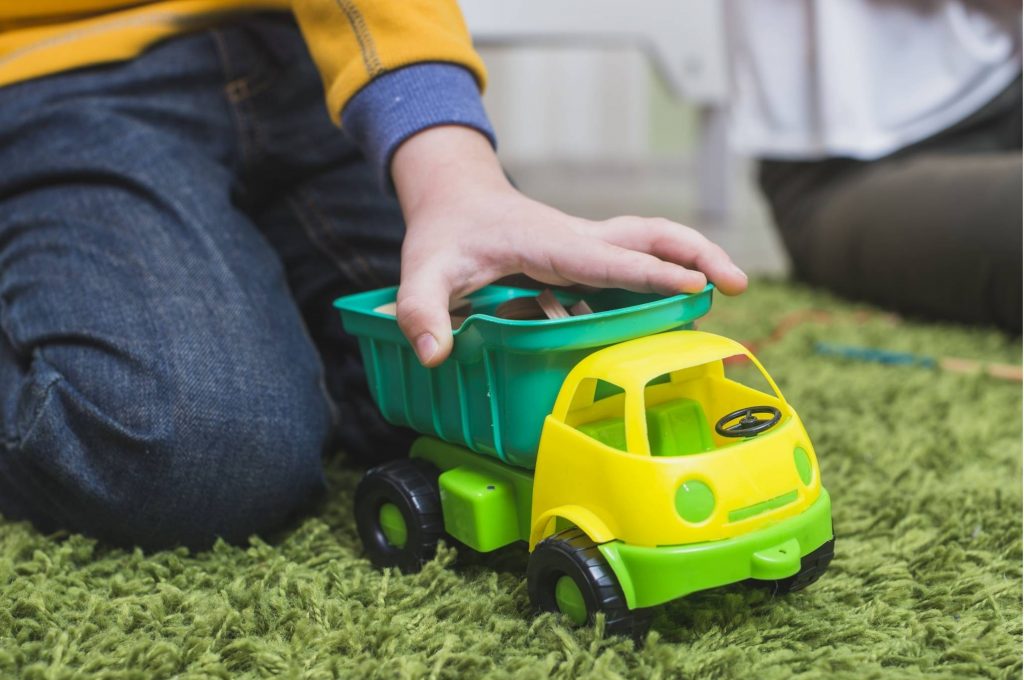
On October 5, 2025, the State Administration for Market Regulation (SAMR) and the Standardization Administration of China (SAC) officially released the four mandatory national standards GB 6675.1–4:2025 Toy Safety. The new standards will come into force on November 1, 2026, fully replacing the GB 6675.1–4:2014 series that has been in use for more than a decade. The revised standards significantly strengthen safety requirements and will reshape toy design, manufacturing, testing, and market access in China.
Key Revisions of the New Standard
1. Significant Expansion of Chemical Safety Requirements
GB 6675.4–2025 introduces limits for more than ten additional hazardous substances, including boron, formaldehyde, total volatile organic compounds (TVOC), and short-chain chlorinated paraffins (SCCPs). It also formally defines soft compound toys such as crystal slime, slime, modeling clay, and squeeze toys, specifies applicable test methods, and improves the criteria for determining accessible parts as well as layered sampling and testing of coatings and substrates.
| Test Item | GB 6675.1-2014 (Old) | GB 6675.4-2025 (New) |
| Migratable Elements | Sb, As, Ba, Cd, Cr, Pb, Hg, Se (8) | Sb, As, Ba, Cd, Cr, Pb, Hg, Se, Boron (9). Boron applies to modeling clay, slime, crystal slime and similar toys. |
| Phthalates | 6 (DEHP, DBP, BBP, DINP, DIDP, DNOP) | 10 (adds DIBP, DPENP, DHEXP, DCHP) |
| Formaldehyde | Not required | Applies to accessible textiles, leather/fur, paper and water-based materials (except finger paints) intended for children under 36 months. |
| AZO Dyes | Not required | Banned in textiles worn by children and in direct skin contact. |
| PAHs | Not required | 8 PAHs controlled in rubber/plastic parts. |
| N-Nitrosamines | Not required | Applies to elastomer parts intended for mouthing or accessible elastomer parts for toys for children under 36 months. |
| Formamide | Not required | Applies to foam materials in toys intended for children under 36 months. |
| SCCPs | Not required | Applies to accessible PVC materials. |
| VOC & TVOC | Not required | Applies to all toy categories except untreated solid wood and pure metal toys. |
| Allergenic Fragrances | Not required | Applies to all scented toys. |
2. Mechanical and Physical Safety
GB 6675.2-2025 adopts ISO 8124-1:2022 with modifications, updating requirements for small parts, sharp points, cords, projectile toys, yo-yos, inflatable toys, and food-imitation toys. It also introduces tip-over tests for large heavy toys and provisions for toys using open flames.
3. Expanded Flammability Requirements
GB 6675.3-2025 adds flammability test methods for face masks, toy tents, dress-up costumes, and stuffed toys, improving fire safety requirements for textile and soft materials.
4. Transition Period
From November 1, 2026, all newly manufactured or imported toys must comply with the new standards. Products manufactured or imported before that date in compliance with the old standards may continue to be sold until October 31, 2027.
Reminder
The revised GB 6675 introduces more than ten new chemical test items, with particular focus on slime toys, electric toys, children’s textile products, foam toys, and food-imitation toys. Manufacturers are advised to conduct compliance assessments and pre-testing as early as possible to ensure a smooth transition.
CMA Testing is a third-party laboratory authorized by the U.S. CPSC and accredited by CNAS and CMA, providing one-stop testing, certification, and compliance services for toys and children’s products.

On December 16, 2024, the European Council formally adopted the Packaging and Packaging Waste Regulation (EU) 2025/40, which was subsequently signed into law by the European Parliament and the Council on December 19. On January 22, 2025, the EU officially published the PPWR in its Official Journal, abolishing the Packaging and Packaging Waste Directive 94/62/EC. The EU Packaging Regulation PPWR entered into force on February 11, 2025, and will be implemented from August 12, 2026 (unless otherwise specified).
Scope of PPWR regulations
Applicable to all packaging and packaging waste, whether such packaging is used in industry, other manufacturing, retail or distribution, office, service or household.
Main contents of PPWR regulations
- Regulations specify requirements for environmental sustainability and labeling throughout the entire lifecycle of packaging.
- Regulations stipulate extended producer responsibility.
- Regulations specify requirements for packaging waste prevention.
PPWR core requirements
Material requirements in packaging
| Packaging type | Requirement |
| All packaging | The total concentration of lead (Pb), cadmium (Cd), mercury (Hg), and hexavalent chromium (Cr6+) is ≤100 mg/kg. |
| Food contact material packaging | The concentration of any single target PFAS substance is <25 ppb (excluding polymeric PFAS); The sum of analyses of the target PFAS substance and optional degradable precursors is <250 ppb (excluding polymeric PFAS); The total PFAS concentration is <50 ppm (including polymeric PFAS). If the total fluorine content exceeds 50 mg/kg, provide proof of the amount of fluorine contained in either PFAS or non-PFAS. |
Packaging recyclability requirements
All packaging placed on the EU market must be recyclable.
Packaging must be designed for recycling and as a substitute for raw materials, and must be collected and sorted separately when it becomes waste.
From 1 January 2030 or 24 months after the enactment of the authorizing act (whichever comes first), only packaging meeting the recycling efficiency level of A, B, or C in Table 3 of Annex II of Regulation (EU) 2025/40 may be placed on the EU market. From 1 January 2038, only packaging meeting the recycling efficiency level of A or B in Table 3 of Annex II may be placed on the EU market.
Minimum Recycling Requirements for Plastic Packaging
| Packaging type | Target date | |
| 1st Jan 2030 | The year of 2040 | |
| Contact-sensitive packaging with polyethylene terephthalate (PET) as the main component (excluding single-use plastic beverage bottles) | 30% | 50% |
| Contact-sensitive packaging made of plastic materials other than PET (excluding single-use plastic beverage bottles) | 10% | 25% |
| Disposable plastic beverage bottles | 30% | 65% |
| Other plastic packaging | 35% | 65% |
Minimize packaging
By January 1, 2030, manufacturers or importers should ensure that the design of packaging placed on the market reduces its weight and volume to the minimum required to ensure its functionality, while taking into account the shape and material of the packaging.
PPWR Regulatory Labeling Requirements
Packaging placed on the market on August 12, 2028, or 24 months from the effective date of the Implementing Act (whichever is latest), should display information on its composition to facilitate consumer classification.
Reusable packaging placed on the market on February 12, 2029, or 30 months from the effective date of the Implementing Act (whichever is latest), should be labeled to inform users that the packaging is reusable. Reusability information and collection points may be provided via QR codes or other types of data carriers.
Plastic packaging with recycled material content labels placed on the market on August 12, 2028, or 24 months from the effective date of the Implementing Act (whichever is latest), should have labels that comply with the Implementing Act.
Single-use plastic packaging is prohibited.
Starting January 1, 2030, the following single-use plastic packaging will be prohibited from being placed on the market:
- Single-use plastic repackaging;
- Suitable for pre-packaged fresh fruits and vegetables weighing no more than 1.5 kg;
- Packaging for ready-to-eat foods and beverages in restaurants and hotels;
- Single-packaged seasonings, sauces, creamer, and sugar packets;
- Small disposable cosmetics and toiletries for the accommodation industry;
- Very lightweight plastic tote bags.
CMA Testing Services
CMA Testing offers testing services for heavy metal limits, PFAS restrictions, SVHC testing, and Declaration of Compliance (DoC) requirements for food contact packaging. For PFAS, we can test for over 400 target substances and screen for total fluoride. Leveraging Q-TOF MS/MS technology, we can screen for over 10,000 PFAS, helping companies easily identify “permanent chemicals” and confidently address compliance challenges. Please feel free to contact us for inquiries!

The Hong Kong Government has gazetted the Toys and Children’s Products Safety Ordinance (Amendment of Schedules 1 and 2) Notice 2026, introducing updates to the safety standards applicable to toys and selected children’s products supplied in Hong Kong. The amendments will take effect on 1 August 2026, allowing a transition period for industry compliance.
Products Affected
The amendment covers:
- Toys (general safety and chemical requirements)
- Children’s high-chairs
- Children’s paints
- Playpens for domestic use
- Wheeled child conveyances (e.g. prams and strollers)
Summary of update
| item | Children’s product | New standard | Current standard |
| 1 | Toys | BS EN 71-3:2019+A2:2024 ‘Migration of certain elements’ | BS EN 71-3:2019+A1:2021 |
| 2 | BS EN 71-4:2020+A1:2025 ‘Experimental sets for chemistry and related activities’ | BS EN 71-4:2020 | |
| 3 | BS EN 71-13:2021+A2:2024 ‘Olfactory board games, cosmetic kits and gustative games’ | BS EN 71-13:2021+A1:2022 | |
| 4 | Children’s highchairs and multi-purpose highchairs for domestic use | BS EN 14988:2017+A2:2024 | BS EN 14988:2017+A1:2020 |
| 5 | Children’s highchairs and multi-purpose highchairs for domestic use | ISO 9221:2024 | ISO 9221-1:2015 ISO 9221-2:2015 |
| 6 | Children’s paints | BS EN 71-3:2019+A2:2024 | BS EN 71-3:2019+A1:2021 |
| 7 | Playpens for domestic use | ASTM F406-24 | ASTM F406-22 |
| 8 | Wheeled child conveyances | AS 2088:2022 (incorporating Amendment 1:2024) | AS 2088:2022 |
Source of the update:
https://www.info.gov.hk/gia/general/202603/13/P2026031300254.htm
https://www.cedb.gov.hk/en/legco-business/questions/2026/pr01042026d.html
Contact our expert team for customized solutions!
Hong Kong Special Administrative Region
Eva Kung
(+852) 2690 8230
evakung@cmatesting.org
Joey Kwok
(+852) 2690 8255
joeykwok@cmatesting.org
Shenzhen, China: Jolin Lin +86 13002021691 jolinlin@cmatesting.org
Shanghai, China: Yuki Zheng +86 13817764175 yukizheng@cmatesting.org
Standard: EN 71-1:2026 – Safety of Toys – Part 1: Mechanical and Physical Properties
Status: published by CEN on Feb 2026
Supersedes: EN 71-1:2014+A1:2018
The European Committee for Standardization (CEN) has published EN 71-1:2026, a comprehensive revision of the mechanical and physical safety requirements for toys placed on the European market. This updated edition replaces EN 71-1:2014+A1:2018 and introduces several important technical clarifications, new test methods, and additional safety requirements.
Note: At the time of publication, EN 71-1:2026 has not yet been cited in the Official Journal of the European Union (OJEU). Harmonisation status should be monitored closely.
Summary of Key Changes in EN 71-1:2026
- Expanding Materials (Clause 4.6)
The requirements for expanding materials have been revised and strengthened. Updated safety criteria apply to materials that swell or expand when exposed to liquids, with clearer assessment conditions to address associated ingestion and obstruction risks.
- Enclosures and Ventilation (Clause 4.14)
Ventilation requirements for toy enclosures have been updated and clarified.
Key changes include:
- More clearly defined ventilation provisions
- Introduction of new test methods to assess airflow and entrapment risks. These updates aim to better address suffocation hazards.
- Toys Intended to Bear the Mass of a Child (Clause 4.15)
Requirements for toys designed to support or bear a child’s weight have been updated. Enhanced structural and mechanical performance criteria apply to improve durability and reduce collapse or failure risks during use.
- Yo-yo Balls (Clause 4.24)
Clarification has been provided for yo-yo balls equipped with tethers. A yo-yo ball is now considered compliant with the requirement if the tether breaks during testing, provided other safety criteria are met.
- Food-Imitation Toys (Clause 4.28)
A new dedicated requirement has been introduced for toys that imitate food. These measures aim to reduce the risk of confusion with real food and mitigate choking or ingestion hazards.
- Toys Intended for Children Under 36 Months (Clause 5)
The scope of requirements for toys intended for children under 36 months has been expanded. The updated standard now explicitly includes glued wooden components, ensuring that bonded parts are adequately assessed for safety.
- Straps and Cords Worn Around the Neck (Clause 5.14)
A new functional requirement has been added for straps, cords, and similar components intended to be worn fully or partially around the neck.
The design must ensure that separated cord parts can be rejoined, improving safety and continued functionality.
- Warnings for Protective Equipment (Clause 7.14.2)
EN 71-1:2026 introduces a new option allowing the use of graphical symbols to indicate that protective equipment must be worn, as an alternative to text-based warnings. This provides greater flexibility while maintaining clear safety communication.
CMA Testing Support
Contact Us
Hong Kong, China:
Eva Kung
- Phone: (+852) 2698 8198
- Mobile phone: (+852) 6321 7993
- Email: evakung@cmatesting.org
Joey Kwok
- Phone: (+852) 2690 8255
- Mobile: (+852) 6059 9644
- Email: joeykwok@cmatesting.org
Shenzhen, China:
Clara Chu
- Phone: (+86) 138 2880 6404
- Email: clarachu@cmatesting.org
Shanghai China:
Yuki Zheng
- Phone: (+86) 021 6433 0500 * 388
- Email: yukizheng@cmatesting.org
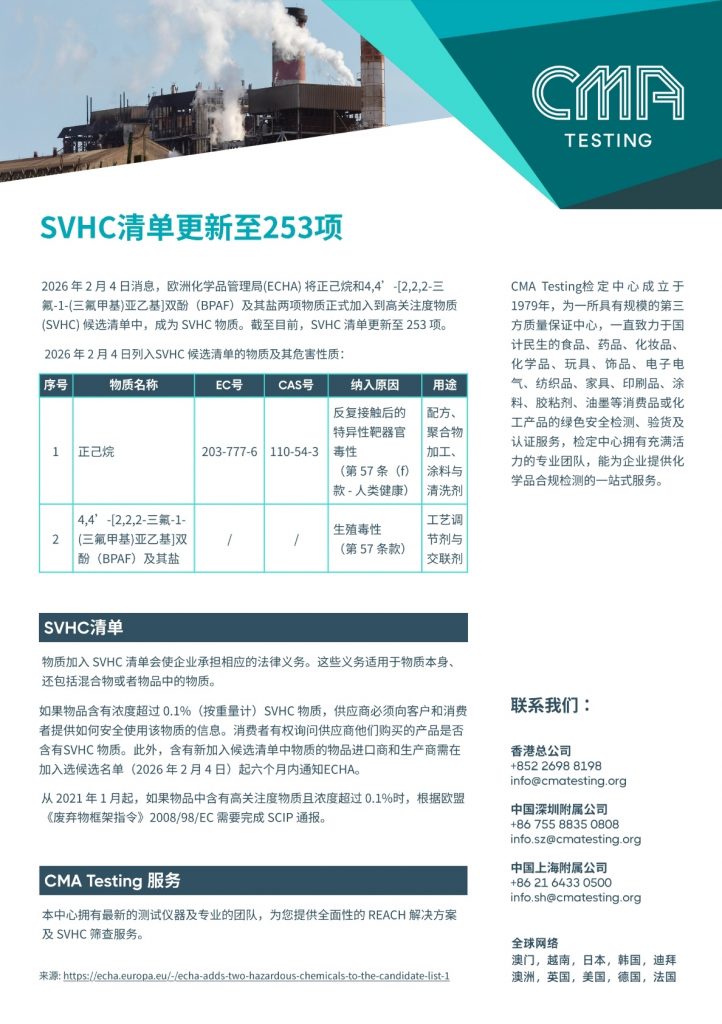
On February 4, 2026, the European Chemicals Agency (ECHA) officially added n-hexane and 4,4′-[2,2,2-trifluoro-1-(trifluoromethyl)ethylidene]bisphenol (BPAF) and its salts to the candidate list of Substances of Very High Concern (SVHCs), thus making them SVHCs. As of now, the SVHC list has been updated to 253 items.
The substances added to the SVHC candidate list on February 4, 2026, and their hazardous properties are described below.
Contact Us
Hong Kong, China:
Eva Kung
- Phone: (+852) 2698 8198
- Mobile phone: (+852) 6321 7993
- Email: evakung@cmatesting.org
Joey Kwok
- Phone: (+852) 2690 8255
- Mobile: (+852) 6059 9644
- Email: joeykwok@cmatesting.org
Shenzhen, China:
Clara Chu
- Phone: (+86) 138 2880 6404
- Email: clarachu@cmatesting.org
Shanghai China:
Yuki Zheng
- Phone: (+86) 021 6433 0500 * 388
- Email: yukizheng@cmatesting.org

In 2020, Japan officially implemented the Positive List system for food contact materials, marking an important first step towards more effective regulation of food contact material.
On 30 May 2025, Japan Government further refine the regulatory framework by issuing a Cabinet Office Notification No.95. The notification amends the Part 3 (which is related to food contact materials) of the Ministry of Health, Labor and Welfare (MHLW) Notification No. 370 of 1959.
The main purpose of the change is to establish the regulatory framework into a system of the positive list (Clause A, which regulates the manufacturing process) and the “negative list” (i.e. Clause D, material-specific standards, which regulates the residue substances in final products).
Below shows the highlights of the amendments imposed by the Notification No.95
- Strengthen the requirements on plastic material – introduce the overall migration requirements (<0.1 mg/cm2), and optimize the test condition for evaporation residue tests;
- Rewrite clause E ( which are specifications for application-specific implements, containers, and packaging) – removing strength test for container and packaging for food sterilized by pressure and heat; while move requirements for drink and milk container/ packaging into the material-specific standards (clause D), and incorporate their test methods into clause B (General testing methods for containers and packaging);
Following shows the summary of testing requirements for different types of food contact materials
The amendment has come into effective, while the amendments on the test requirements for plastic material will come into effective on 1 June 2026.
| Materials | Total lead and total cadmium | Heavy metals as lead | Evaporation residue/ overall migration | Consumption of KMnO4 | Others |
| Glass, ceramic and enamel | Leachable cadmium and lead | ||||
| Phenolic, urea, and melamine resins | x | x | x | Phenol and formaldehyde | |
| Formaldehyde resins | x | x | x | x | Formaldehyde |
| Polyvinyl chloride resin | x | x | x | x | Dibutyltin, Tricresyl phosphates, and vinyl chloride monomer |
| Polyethylene and polypropylene resins | x | x | x | x | – |
| Polystyrene resin | x | x | x | x | Volatile compounds |
| Vinylidene chloride resin | x | x | x | x | Barium and vinylidene chloride monomer |
| Polyethylene terephthalate resin | x | x | x | x | Antimony and germanium |
| Polymethyl methacrylate resin | x | x | x | x | Methyl methacrylate |
| Polyamide resin | x | x | x | x | Caprolactam |
| Polymethylpentene resin | x | x | x | x | – |
| Polycarbonate resin | x | x | x | x | Bisphenol A, Diphenyl carbonate, and amines |
| Polyvinyl alcohol resin | x | x | x | x | – |
| Polylactic acid resin | x | x | x | x | Lactic acid |
| Polyethylene naphthalate resin | x | x | x | x | Germanium |
| Other plastic resins | x | x | x | – | |
| Rubber materials | x | x | x | Mercaptoimidazoline, Phenol, formaldehyde, zinc | |
| Metal cans | x | x | Arsenic, phenol, formaldehyde, epichlorohydrin, and vinyl chloride monomer |
The amendment has come into effective, while the amendments on the test requirements for plastic material will come into effective on 1 June 2026.
https://www.cmatesting.org/wp-content/uploads/2026/01/EN.pdf

On 26 November 2025, the new Toy Safety Regulation (EU) 2025/2509 was adopted in Strasbourg and published in the EU Official Journal on 12 December 2025. It replaces the previous Toy Safety Directive 2009/48/EC and applies directly in all Member States. The goal: greater safety for children and clear rules for the industry. CMA Testing welcomes the new regulation as an important step towards an even higher level of protection for children and greater transparency in the European single market.
Key Changes at a Glance
- Stricter Chemical Controls
Ban on CMR substances (carcinogenic, mutagenic, toxic for reproduction), endocrine disruptors, PFAS (“forever chemicals”), and over 30 bisphenols.
Tougher migration limits for heavy metals and BPA – only technically unavoidable traces are allowed. - Expanded Safety Assessments
All toys must undergo comprehensive checks for chemical, mechanical, electrical, fire, hygiene, and radiation safety. - Digital Product Passport (DPP)
Every toy must include a Digital Product Passport (e.g., via QR code) with CE marking, safety data, and traceability information. - Regulation of Connected Toys & AI
Toys with microphones, cameras, or AI features are subject to additional assessments under the AI Act, Cyber Resilience Act, and Radio Equipment Directive. - Obligations for Online Marketplaces
Platforms must ensure CE marking, safety warnings, and DPP visibility.
Implementation Timeline
- Entry into force: 20 days after publication (early January 2026).
- Full application: from 1 August 2030 – with a transition period of 54 months.
What Does This Mean for Manufacturers?
| Area | Actions |
|---|---|
| Product Development | Review materials, eliminate banned substances, comply with new limits. |
| Safety Processes | Expand testing, integrate new risk categories. |
| Digital Infrastructure | Build systems for creating and integrating DPPs. |
| E-Commerce | Update product listings with CE marking, warnings, and DPP access. |
| Supply Chain | Align with manufacturers, importers, and conformity assessment bodies. |
Opportunities for the Industry
- Build trust: Transparency and safety as a competitive advantage.
- Act early: Avoid bottlenecks and costs by adapting now.
- Drive innovation: Develop safer materials and smart compliance solutions.
How can CMA Testing help you with the new toys regulation?
- We are an ISO 17025 accredited lab. We can provide testing in compliance with harmonized standards referenced in Regulation (EU) 2025/2509
- Technical file support, test plan and test protocol preparation
- Safety assessment support for physical, chemical, electrical, and microbial safety-related risks
- Testing support for wireless and connected toys
- Inspections and factory audits
- Digital product passport preparation support
Act now:
If you place toys on the EU market, now is the time to:
- map your product portfolio;
- evaluate chemical and digital risks; and
- prepare for the Digital Product Passport and the updated documentation requirements.
To find out more about compliance for toys, do not hesitate to contact.
| Contact us | Phone | |
| Clara Chu | clarachu@cmatesting.org | 0755 8835 0808 – 8031 |
| Yuki Zheng | yukizheng@cmatesting.org | 021-64330500-338 |

On 5 November 2025, the European Chemicals Agency (ECHA) has added 1,1′-(ethane-1,2-diyl)bispentabromobenzene to the candidate list of substances of very high concern (SVHC). The Candidate List of SVHC now contains 251 entries for chemicals.
Entry added to the Candidate List on 5 November 2025:
| Substance Name | EC No. | CAS No. | Reason for inclusion | Use |
| 1,1′-(ethane-1,2-diyl)bis[pentabromobenzene] (DBDPE) | 284-366-9 | 84852-53-9 | Very persistent and very bioaccumulative, vPvB (Article 57e)) | Flame retardant |
Under REACH, companies have legal obligations when their substance is included – either on its own, in mixtures or in articles – in the Candidate List.
If an article contains a Candidate List substance above a concentration of 0.1 % (weight by weight), suppliers have to give their customers and consumers information on how to use it safely. Consumers have the right to ask suppliers if the products they buy contain substances of very high concern. Importers and producers of articles have to notify ECHA if their article contains a Candidate List substance within six months from the date it has been included in the list (5 November 2025).
Under the Waste Framework Directive, companies also have to notify ECHA if the articles they produce contain substances of very high concern in a concentration above 0.1 % (weight by weight). This notification is published in ECHA’s database of substances of concern in products (SCIP).
Source: https://echa.europa.eu/-/echa-adds-one-hazardous-chemical-to-the-candidate-list-2

What is Amazon DV (Direct Validation)?
Recently, to ensure product safety and compliance, Amazon has required that all toys category products must undergo Direct Validation (DV) through Amazon-recognized Testing, Inspection and Certification (TIC) bodies. This requirement covers major Amazon sites in the United States, Canada, and Europe.
Under this policy, sellers can no longer upload compliance documents by themselves. Instead, test results are submitted directly to Amazon by TIC laboratories. Failure to complete validation, or results showing non-compliance with Amazon’s policies, may lead to product removal or delisting.
In this high-standard, time-sensitive compliance model, testing services are no longer a “supplementary step,” but a critical process integrated into the entire product launch workflow.
Since Amazon sets strict entry requirements for TIC partners, only laboratories with proven expertise and strong performance capabilities are selected. CMA Testing is proud to be recognized by Amazon as a qualified TIC laboratory to provide DV (Direct Validation) services, a testament to our commitment to compliance excellence and testing quality.
CMA Testing – Your Compliance Partner for Amazon
As an Amazon-recognized TIC laboratory, CMA Testing provides:
- Comprehensive toy compliance testing services across multiple categories
- Global regulatory support, including REACH, RoHS, PFAS, CPSIA, FDA
- One-stop technical documentation support (DoC preparation, labeling review, packaging compliance)
- English test reports fully meeting Amazon’s requirements
Whether you are expanding your Amazon business or preparing to launch new products quickly, CMA Testing is your trusted compliance partner. With our professional and efficient services, we help your products enter the global marketplace safely and swiftly.