




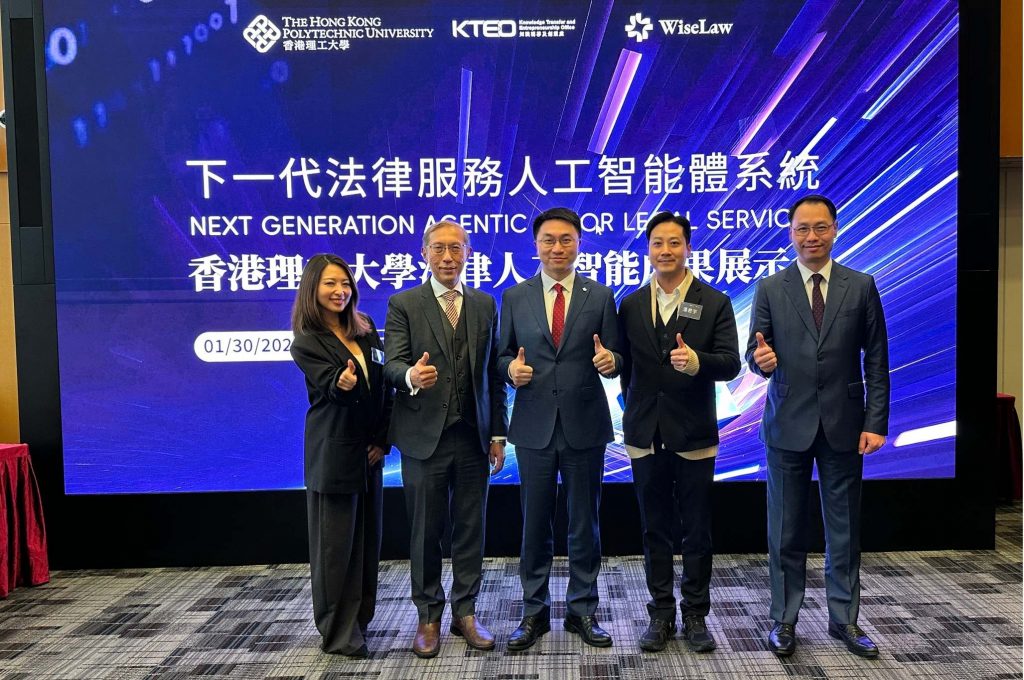
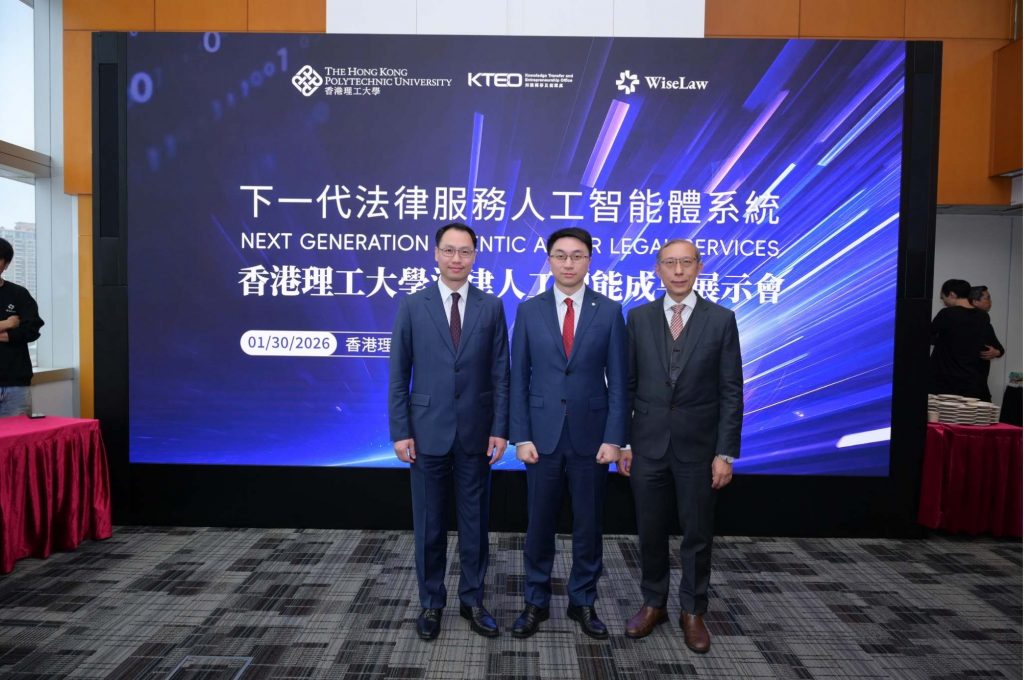
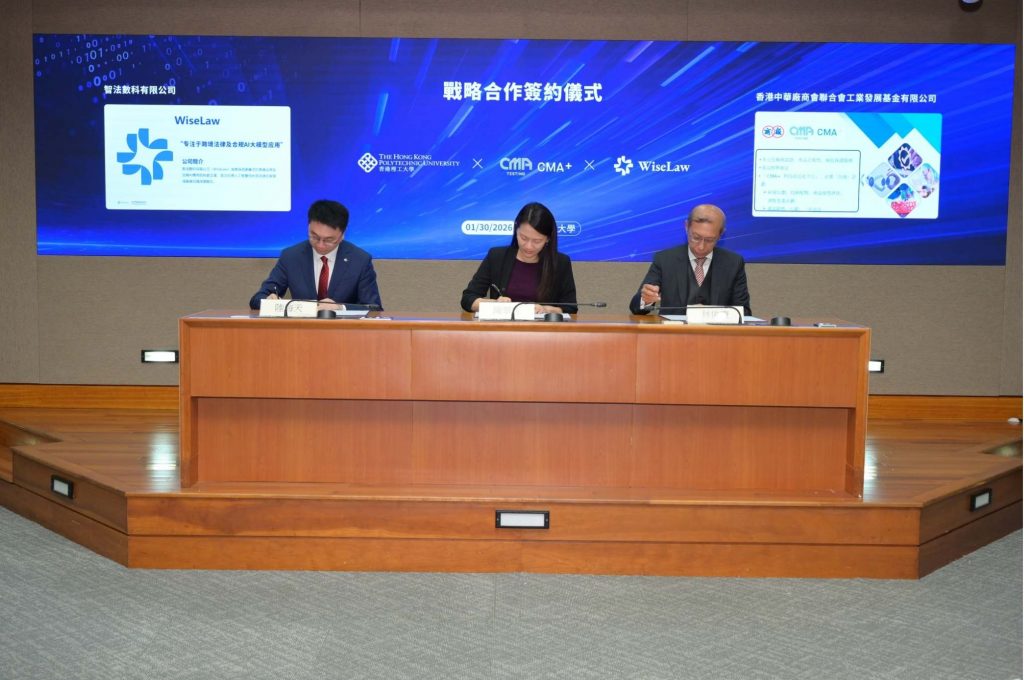
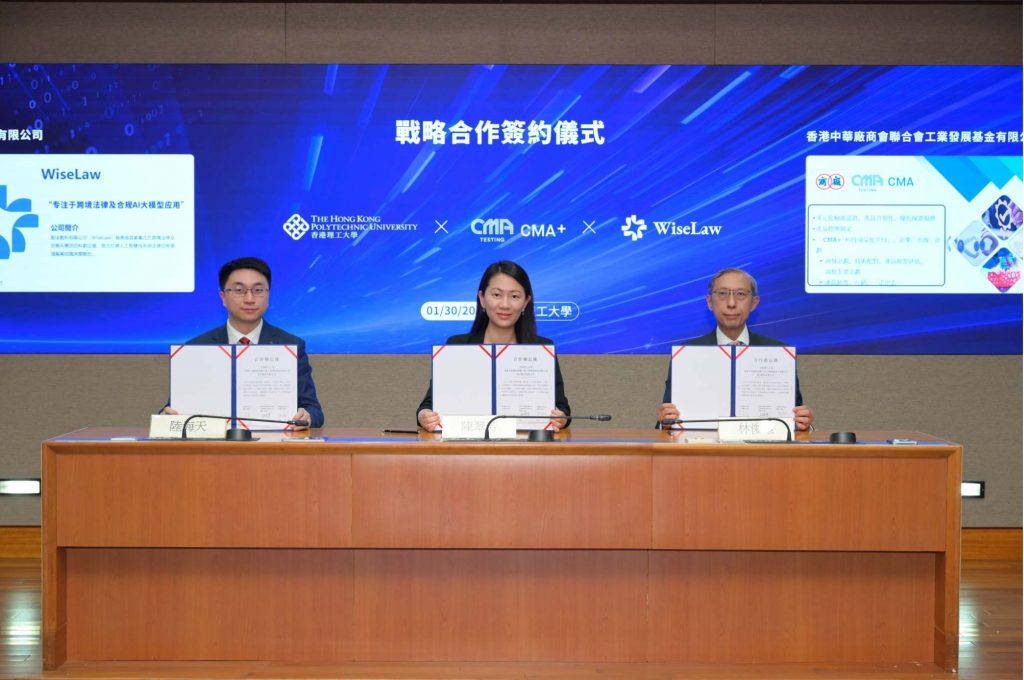
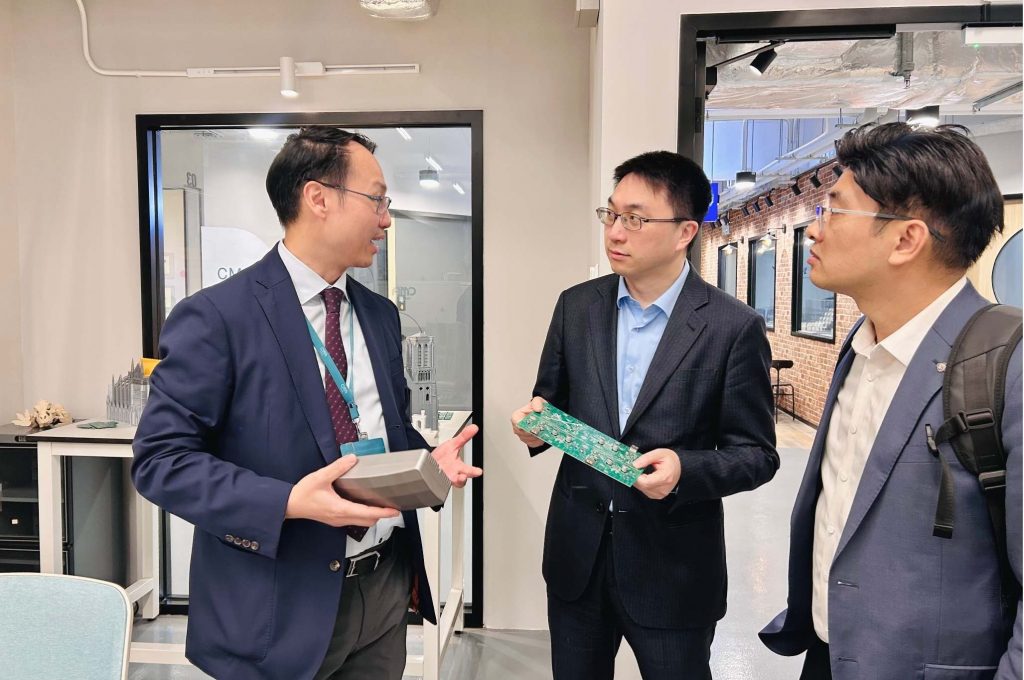
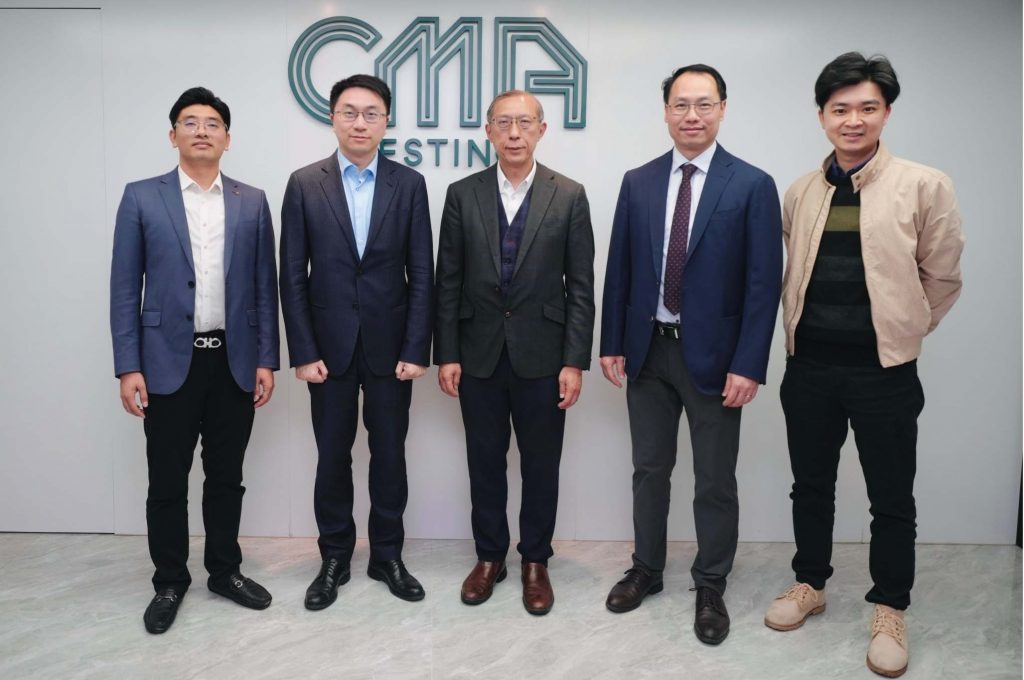
On January 30th, CMA Testing, together with CMA+, participated in the “Hong Kong Polytechnic University 2026 Legal Artificial Intelligence Achievements Exhibition” and signed a tripartite memorandum of understanding with Hong Kong Polytechnic University and WiseLaw Limited. This collaboration aims to integrate top-tier academic research, cutting-edge legal technology, and mature commercialization capabilities to jointly build an innovative cooperation model oriented towards industry support, capacity building, and knowledge dissemination, providing a comprehensive and intelligent support system for Chinese enterprises going global.
This collaboration marks another step forward for CMA+, a subsidiary of CMA Testing, in its strategic layout of building an integrated professional service ecosystem encompassing “business, technology, and law.” Previously, we had established strategic alliances with Yingke Law Firm, Beijing Yingke (Hong Kong) Law Firm, and SESG Enterprise, bringing together professional strengths in the three major areas of business technology, law, and wealth management to form a basic service framework supporting enterprises and talent going global. Now, with the addition of cutting-edge research capabilities from top universities and intelligent solutions from legal technology companies, the platform’s service scope has been further deepened and expanded, providing overseas-bound enterprises with full-chain, customized support from strategic consulting, legal compliance, and technology certification to the commercialization of research results.
In his welcoming address, Professor Christopher CHAO, Senior Vice-President of the Hong Kong Polytechnic University, stated, “Hong Kong, backed by the motherland and connected to the world, possesses the unique advantages of a common law system. Leveraging the power of technology, Hong Kong has the potential to play a significant role in cross-border legal technology innovation. WiseLaw, as a model of industry-academia-research collaboration nurtured by PolyU’s PolyVenture entrepreneurial ecosystem, demonstrates how cutting-edge academic research can be transformed into practical tools to support enterprises going global, vividly embodying PolyU’s innovative culture integrated into the rule of law.”
In his address, Dr. Horace Cheung, SBS, JP, Deputy Secretary for Justice of the Hong Kong Special Administrative Region, emphasized that under the national strategy of high-level opening-up, the Hong Kong legal profession must make good use of technology to improve the efficiency and quality of cross-border legal services. He affirmed the efforts and breakthroughs of PolyU and WiseLaw in promoting legal technology and looked forward to more original Hong Kong legal technology achievements serving the Greater Bay Area and even the world.
In the future, the three parties will rapidly advance specific collaborative projects, focusing on four core areas: overseas legal support and ecosystem empowerment; exploration of co-construction of testing, certification, and compliance intelligence entities; in-depth commercialization of research results and technology transfer; and brand collaboration and marketing activities. The aim is to provide Chinese enterprises going global with practical tools, services, and knowledge outcomes as soon as possible, jointly embracing new opportunities and challenges in the global market.
This collaboration actively responds to the service direction advocated by the Hong Kong SAR Government’s “Mainland Enterprises Going Global Task Force.” The Task Force has emphasized the need to gather comprehensive, customized professional services covering taxation, law, financing, testing and certification, ESG, and intellectual property rights to help enterprises expand into markets such as Southeast Asia and the Middle East. This collaboration among the three parties aims to build a more integrated, intelligent, and market-responsive ecosystem to support businesses going global, providing them with truly one-stop solutions and growth momentum.

In 2020, Japan officially implemented the Positive List system for food contact materials, marking an important first step towards more effective regulation of food contact material.
On 30 May 2025, Japan Government further refine the regulatory framework by issuing a Cabinet Office Notification No.95. The notification amends the Part 3 (which is related to food contact materials) of the Ministry of Health, Labor and Welfare (MHLW) Notification No. 370 of 1959.
The main purpose of the change is to establish the regulatory framework into a system of the positive list (Clause A, which regulates the manufacturing process) and the “negative list” (i.e. Clause D, material-specific standards, which regulates the residue substances in final products).
Below shows the highlights of the amendments imposed by the Notification No.95
- Strengthen the requirements on plastic material – introduce the overall migration requirements (<0.1 mg/cm2), and optimize the test condition for evaporation residue tests;
- Rewrite clause E ( which are specifications for application-specific implements, containers, and packaging) – removing strength test for container and packaging for food sterilized by pressure and heat; while move requirements for drink and milk container/ packaging into the material-specific standards (clause D), and incorporate their test methods into clause B (General testing methods for containers and packaging);
Following shows the summary of testing requirements for different types of food contact materials
The amendment has come into effective, while the amendments on the test requirements for plastic material will come into effective on 1 June 2026.
| Materials | Total lead and total cadmium | Heavy metals as lead | Evaporation residue/ overall migration | Consumption of KMnO4 | Others |
| Glass, ceramic and enamel | Leachable cadmium and lead | ||||
| Phenolic, urea, and melamine resins | x | x | x | Phenol and formaldehyde | |
| Formaldehyde resins | x | x | x | x | Formaldehyde |
| Polyvinyl chloride resin | x | x | x | x | Dibutyltin, Tricresyl phosphates, and vinyl chloride monomer |
| Polyethylene and polypropylene resins | x | x | x | x | – |
| Polystyrene resin | x | x | x | x | Volatile compounds |
| Vinylidene chloride resin | x | x | x | x | Barium and vinylidene chloride monomer |
| Polyethylene terephthalate resin | x | x | x | x | Antimony and germanium |
| Polymethyl methacrylate resin | x | x | x | x | Methyl methacrylate |
| Polyamide resin | x | x | x | x | Caprolactam |
| Polymethylpentene resin | x | x | x | x | – |
| Polycarbonate resin | x | x | x | x | Bisphenol A, Diphenyl carbonate, and amines |
| Polyvinyl alcohol resin | x | x | x | x | – |
| Polylactic acid resin | x | x | x | x | Lactic acid |
| Polyethylene naphthalate resin | x | x | x | x | Germanium |
| Other plastic resins | x | x | x | – | |
| Rubber materials | x | x | x | Mercaptoimidazoline, Phenol, formaldehyde, zinc | |
| Metal cans | x | x | Arsenic, phenol, formaldehyde, epichlorohydrin, and vinyl chloride monomer |
The amendment has come into effective, while the amendments on the test requirements for plastic material will come into effective on 1 June 2026.
https://www.cmatesting.org/wp-content/uploads/2026/01/EN.pdf
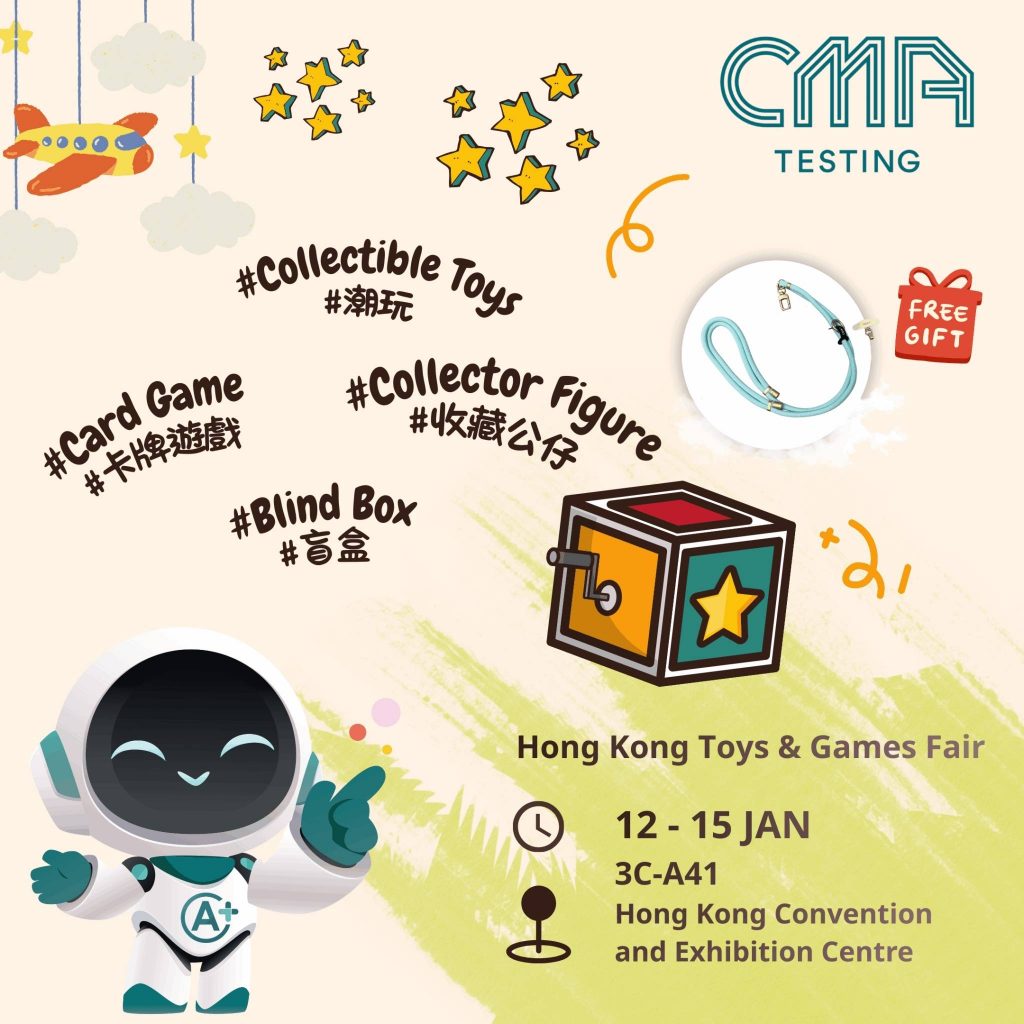
Visit us at Booth 3C-A41, Hong Kong Convention and Exhibition Centre, from 12–15 January 2026! We provide comprehensive and professional toy testing solutions covering key international standards, including:
 EU: EN71, EN62115, EMC, REACH, RoHS
USA: CPSIA, CPSC, ASTM F963
Japan: JFSL, ST, PSC
China: CCC (GB6675)
Australia/NZ: AS/NZS ISO8124
Canada: CCPSA
Your products deserve the most rigorous compliance support. No matter your target market, we help you move forward seamlessly.
For testing inquiries, contact our expert team:
Eva Kung
Phone: (+852) 2690 8230
Email: evakung@cmatesting.org
 Like, Share & Visit for a Free Gift!
Like and share this post, then visit our booth to receive a “Dr. A+ lanyard” . Limited stock available!

To enhance site safety, The Buildings Department has issued a Practice Note for Registered Contractors (PNRC) 851,requiring Registered Contractors to arrange to take samples and conduct testing on protective materials in the manner specified inthe PNRC. The testing must be conducted by laboratories designated by the Government and accredited under the Hong KongLaboratory Accreditation Scheme (HOKLAS) or by Mutual Recognition Arrangements partners of HOKLAS. We are pleased to announce that CMA Testing Centre is now officially a HOKLAS-accredited laboratory meeting this requirement.
We provide the industry with comprehensive and authoritative flame retardancy testing services for protective materials, in strict compliance with:
✅ GB/T 5455-2014 (meeting relevant clauses of GB 5725-2009 & 2025)
✅ BS EN ISO 15025:2002 / 2016 (Procedure A – Surface ignition)
✅ BS 5867-2:2008 (Type ‘B’ performance requirements)
📞 For enquiries or test scheduling:
Eva Kung
Tel: (+852) 2698 8198
Whatapp: (+852) 6321 7993
Email: info@cmatesting.org
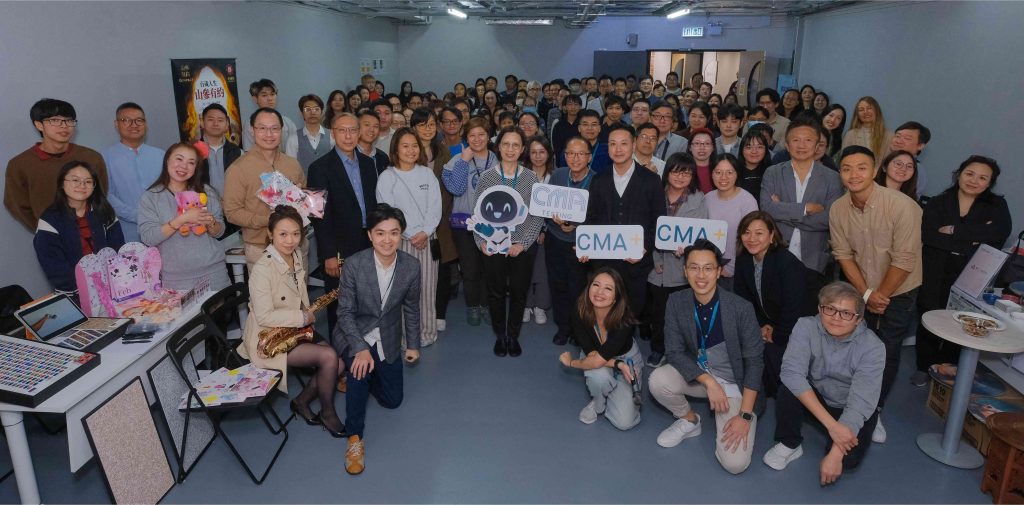
A heartfelt thank you to all the entrepreneurs, brand partners, social enterprises, and NGOs who made our festive marketplace a vibrant celebration of innovation and social responsibility!
From inspiring booths and interactive workshops to meaningful networking, every moment was lit up by your presence.
Relive the memories and highlights of the day now! Check out our event recap video here.
Thank you once again to everyone who joined us. Let’s continue to explore the limitless possibilities where technology meets purpose.
See you next time!